

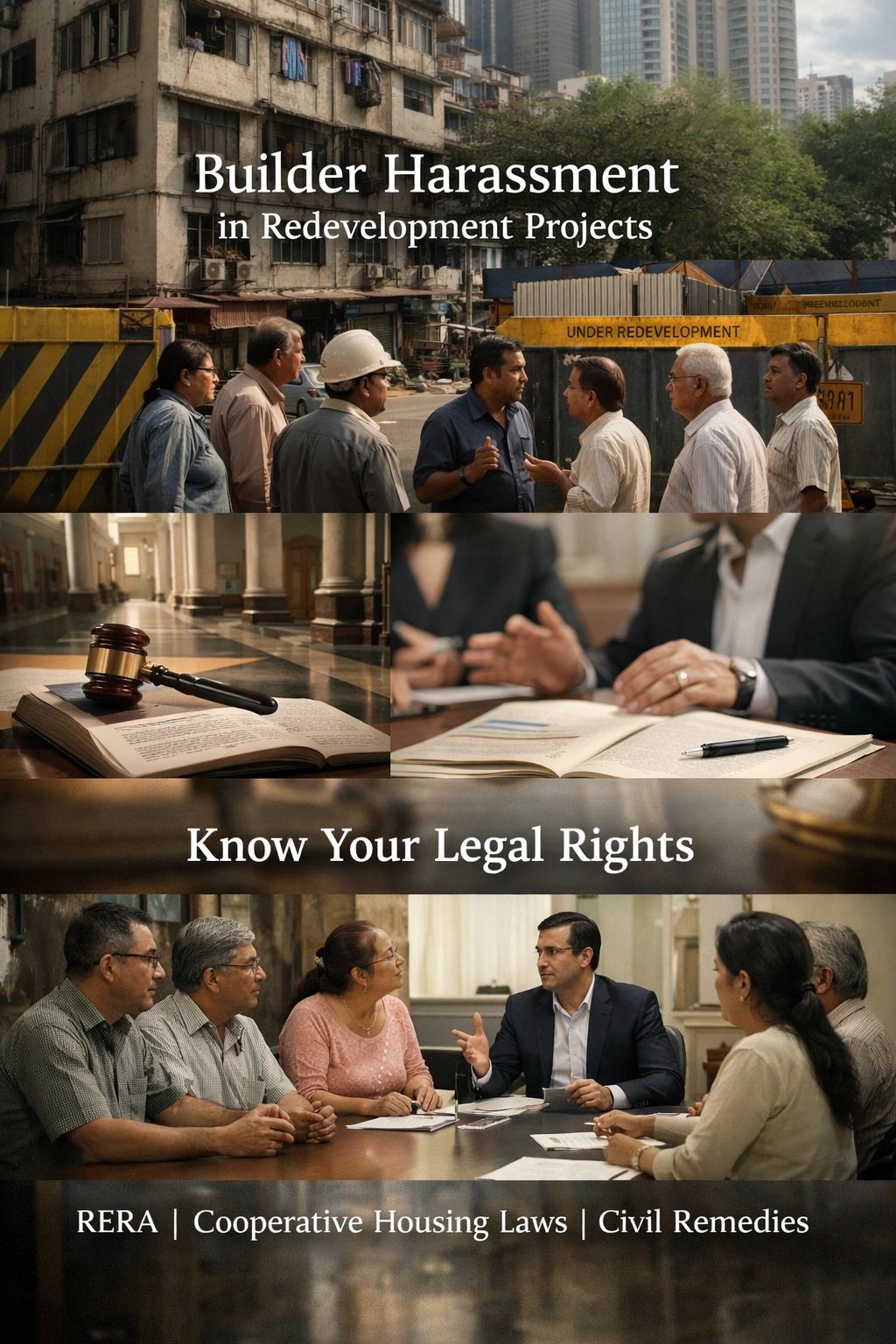
Builder Harassment in Redevelopment Projects: Legal Remedies for Housing Societies.
Redevelopment of housing societies has become a necessity in metropolitan cities like Mumbai, where ageing buildings, safety concerns, and redevelopment incentives intersect. While redevelopment promises modern homes and better amenities, the process is often riddled with conflict. Housing societies frequently face pressure tactics, intimidation, delays, and non-compliance by builders.
This blog by Asahi Legal LLP examines the practical and legal challenges housing societies face during redevelopment—popularly described as “bumps, bash and bouncers”—and outlines the legal safeguards available to societies under Indian law.
Understanding the Reality of Redevelopment Disputes
Redevelopment disputes are rarely limited to paperwork. In many cases, they spill over into day-to-day life of society members. Common issues reported by societies include:
- Coercive tactics to force consent
- Entry of unauthorised persons or security staff into society premises
- Threats or harassment of managing committee members
- Arbitrary stoppage of essential services
- Deliberate delay in construction timelines
- Failure to honour contractual commitments
Such practices are not only unethical but may also amount to civil and criminal offences, depending on the facts of each case.
The Legal Framework Governing Redevelopment
Redevelopment of cooperative housing societies is governed by a combination of:
- The Maharashtra Cooperative Societies Act, 1960
- Government Resolutions issued by the State of Maharashtra
- The Indian Contract Act, 1872
- The Real Estate (Regulation and Development) Act, 2016 (RERA)
- Municipal laws and Development Control Regulations
A builder does not have unfettered rights merely because a development agreement is executed. Their authority is limited by statutory obligations and contractual terms.
Strong‑Arm Tactics by Builders: Legal Consequences
1. Intimidation and Use of Force
Any act involving threats, intimidation, or use of muscle power—including deployment of private bouncers—can attract provisions under the Indian Penal Code, such as criminal intimidation, trespass, and unlawful restraint.
Housing societies are well within their rights to:
- File a police complaint
- Seek injunctions from civil courts
- Approach the Registrar of Cooperative Societies
2. Illegal Entry and Trespass
Until lawful possession is handed over, a builder cannot forcibly enter society premises or obstruct residents’ peaceful use of property. Any unauthorised entry may amount to criminal trespass.
Courts have consistently held that possession follows due process—not pressure.
Delays and Non‑Performance by Builders
One of the most common grievances in redevelopment projects is delay in completion. Builders often cite regulatory approvals or financial constraints, but delays beyond agreed timelines can have serious legal implications.
Housing societies may:
- Invoke penalty clauses under the development agreement
- Claim alternate accommodation rent with interest
- Seek termination of the agreement for breach
- File complaints under RERA for delay and compensation
RERA has emerged as a powerful remedy, offering time‑bound adjudication and monetary relief.
Importance of Development Agreement and Due Diligence
Most redevelopment disputes arise due to poorly drafted agreements or lack of due diligence at the initial stage. A robust development agreement should clearly specify:
- Construction timelines
- Rent and hardship compensation
- Penalty clauses for delay
- Specifications and amenities
- Dispute resolution mechanisms
- Exit clauses in case of default
At Asahi Legal LLP, we emphasise that legal vetting at the pre‑redevelopment stage can prevent years of litigation.
Role of Managing Committee and General Body
The managing committee acts as a trustee for society members. Decisions taken without transparency or contrary to statutory guidelines may be challenged by members.
Key best practices include:
- Maintaining proper records and resolutions
- Ensuring informed consent of members
- Avoiding unilateral decisions
- Seeking legal advice before executing binding documents
A well‑advised committee is the first line of defence against coercive builders.
Remedies Available to Housing Societies
Housing societies are not helpless. Depending on the situation, they may approach:
- Civil Courts for injunctions and damages
- RERA Authorities for delay and non‑compliance
- Registrar of Cooperative Societies for statutory violations
- Police Authorities in cases involving criminal conduct
- Arbitration if contractually agreed
Each remedy serves a distinct purpose and must be strategically chosen.
Why Legal Strategy Matters in Redevelopment
Redevelopment disputes are time‑sensitive and emotionally charged. An unstructured response often strengthens the builder’s position. A legally sound strategy ensures:
- Protection of members’ rights
- Accountability of the developer
- Continuity of essential services
- Timely completion or lawful exit
How Asahi Legal LLP Assists Housing Societies
Asahi Legal LLP has extensive experience in advising housing societies, managing committees, and individual members on redevelopment‑related disputes. Our services include:
- Legal due diligence of redevelopment proposals
- Drafting and vetting of development agreements
- Representation before RERA and courts
- Advisory on termination and re‑appointment of developers
- Crisis management during redevelopment conflicts
Our approach balances legal precision with practical solutions.
Conclusion
Redevelopment is meant to rebuild homes—not break trust. While aggressive tactics by builders are unfortunately common, the law provides strong remedies for housing societies that act promptly and strategically.
With the right legal guidance, societies can navigate the bumps, resist the bash, and keep the bouncers at bay.
For expert legal assistance on housing society redevelopment, consult Asahi Legal LLP.
This article is for general information only and is not legal advice or an invitation to engage the firm. Laws and judgments change; please obtain specific legal advice before acting.