

As we navigate the urban landscape of 2026, the redevelopment of aging housing societies has shifted from a luxury to a structural necessity. With over 30,000 buildings in Mumbai alone surpassing the 30-year mark, the stakes for a “water-tight” Development Agreement (DA) have never been higher.
The DA is the single most important document in your society’s history. It is a multi-crore contract that dictates your quality of life for the next three to five years. Yet, many societies sign these documents based on “trust” or “builder reputation,” only to find themselves in the clutches of “zombie projects” or legal deadlocks.
This 3,500-word masterclass uncovers the subtle and overt red flags that could jeopardize your home.
I. The Timeline & Approval Minefield
The most common way projects fail is through “intentional stagnation.” A developer may hold your development rights without actually starting work, waiting for FSI prices to fluctuate or interest rates to drop.
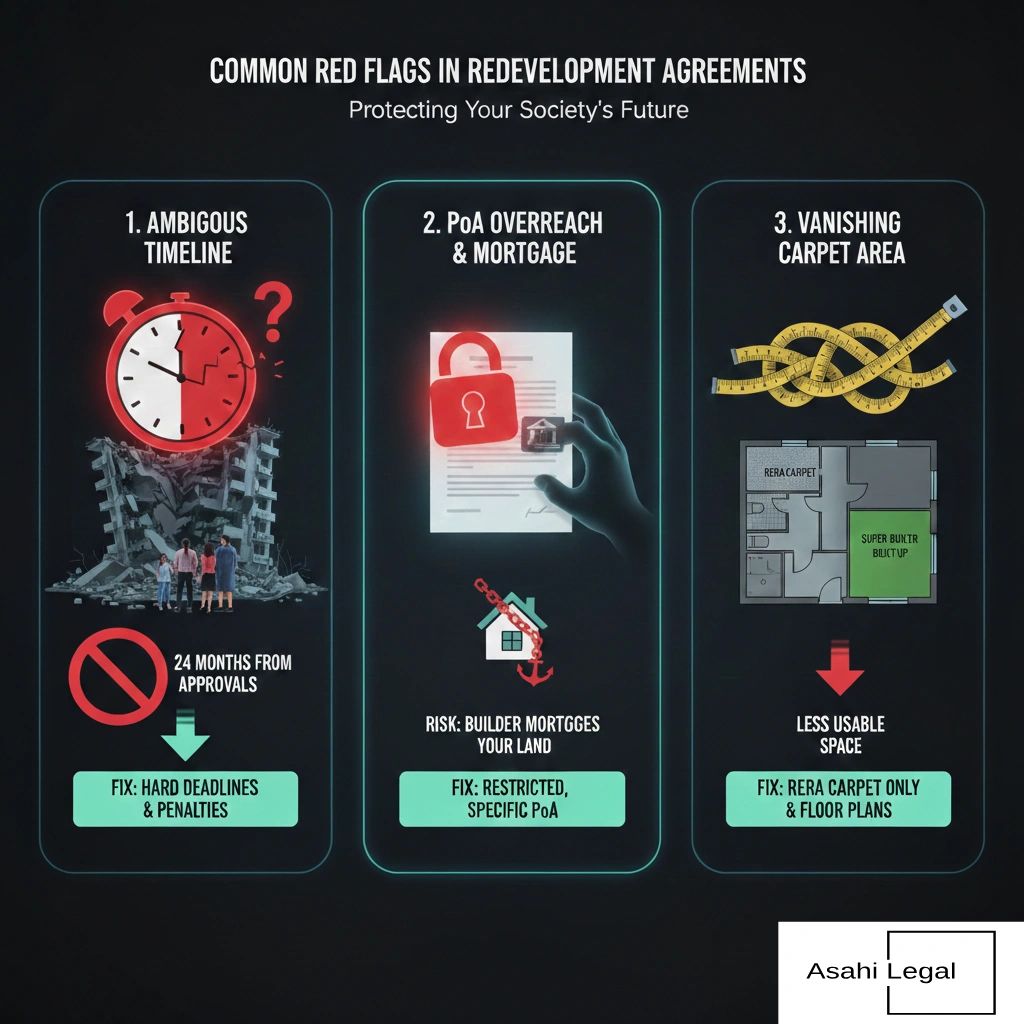
1. The “Date of Receipt of Approvals” Loophole
The Red Flag: A clause stating construction will finish “within 24 months from the date of receipt of all approvals.”
The Risk: The developer has no incentive to get those approvals quickly. They could sit on the file for three years, and technically, your 24-month clock hasn’t even started.
The Fix: * Hard Stop Dates: Use “Long Stop Dates.” The agreement must state: “The Developer shall obtain the IOD (Intimation of Disapproval) within 6 months and the CC (Commencement Certificate) within 9 months of the execution of this DA.”
- Automatic Termination: If these dates are missed, the Society should have the right to terminate without notice.
2. Failure to Link Vacating to the CC
The Red Flag: A clause asking members to vacate within 30 days of signing the DA.
The Risk: You move out, the building is demolished, but the builder doesn’t have the Commencement Certificate (CC). You are now a “tenant” with no home to go back to and a builder who hasn’t even legally started.
The Fix: No CC, No Vacating. Members should only hand over possession after the developer produces a valid, full CC and has paid the first 12 months of rent in advance.
II. The Power of Attorney (PoA) & Land Security
The land is the only asset your society owns. The Developer Agreement gives the builder “Development Rights,” but many try to sneak in “Ownership Rights.”
3. The Mortgage Clause
The Red Flag: A clause allowing the developer to “create a charge or mortgage” on the property to raise funds.
The Risk: If the developer defaults on a bank loan, the bank will seize your society’s land. You will be homeless, and your land will be auctioned to pay the builder’s debt.
The Fix: Explicit Prohibition. The DA must state: “The Developer shall not have the right to mortgage, charge, or encumber the Society’s land or the Rehab units. Only the ‘Free Sale’ component may be used as collateral, subject to a No-Objection Certificate (NOC) from the Society.”
4. Irrevocable General Power of Attorney
The Red Flag: A GPA that is “irrevocable” and “unconditional.”
The Risk: Even if you terminate the developer for non-performance, they might still use the GPA to sign documents or deal with authorities on your behalf, creating a “cloud” on your title.
The Fix: The GPA must be co-terminus with the DA. If the DA is terminated, the GPA automatically becomes null and void. Ensure the GPA is registered and clearly lists only “agentic” powers (e.g., applying for water connection) rather than “discretionary” powers.
III. Financial Red Flags: Rent, Corpus, and Guarantees
In 2026, liquidity is king. A builder who cannot secure your rent is a builder who cannot finish your building.
5. The “Rent Default” Silence
The Red Flag: An agreement that doesn’t explain what happens if rent stops.
The Risk: Developers often pay rent for the first year and stop when the “Sale Component” isn’t selling. Litigation to recover rent can take years.
The Fix: * Escrow for Rent: The developer must deposit 24 months of rent into a dedicated Escrow Account before demolition.
- Post-Dated Cheques (PDCs): Insist on PDCs for the entire projected period of redevelopment.
- Stop-Sale Rights: If rent is delayed by more than 30 days, the Society must have the legal right to stop the builder from selling any “Free Sale” flats.
6. The “Soft” Bank Guarantee
The Red Flag: A Bank Guarantee (BG) that expires before the project finishes, or a BG that is only 5% of the project cost.
The Risk: It’s a paper tiger. By the time you try to encash it, it’s expired or the amount is too small to cover the cost of finishing a stalled building.
The Fix: * Amount: Minimum 20% of the total construction cost.
- Validity: Must be valid until the Occupancy Certificate (OC) is received, plus a 6-month “claim period.”
- Invocation: It must be an “Unconditional & Irrevocable” guarantee that the Society can encash without a court order.
IV. Technical & Space Scrutiny: Protecting the “Carpet”
- The “Built-Up Area” Deception
The Red Flag: The agreement promises “30% extra area on your existing area” without defining “existing area.”
The Risk: Does 30% extra include the balcony? The flower bed? In 2026, under DCPR 2034, “Fungible FSI” is a specific legal tool. If the builder isn’t specific, you might end up with a smaller usable flat than you had before.
The Fix: Use RERA Carpet Area only. The DA must have a schedule (Schedule ‘B’) which lists:
- Existing Carpet Area (as per old plans).
- Additional Area (due to FSI/TDR).
- Total New RERA Carpet Area.
- The “Loading” Trap
The Red Flag: Clauses mentioning “loading” of 35-40%.
The Risk: “Loading” is an unofficial term used to inflate prices by adding common areas (lifts, stairs) to your flat’s area. It is legally meaningless under RERA but often used to confuse society members.
The Fix: Demand a detailed floor plan as an annexure to the agreement. If the plan isn’t attached, the agreement is incomplete.
V. Termination & Exit Strategy
Every marriage needs a pre-nuptial; every DA needs an Exit Clause.
- Lack of “Force Majeure” Clarity
The Red Flag: A clause that excuses the builder for “any delay beyond the developer’s control.”
The Risk: Builders will claim a “cement shortage” or “labor strike” as Force Majeure to avoid paying penalties for years.
The Fix: Define Force Majeure strictly. It should only include “Acts of God” (Earthquakes, Floods) or “War.” Changes in government policy or market downturns are not Force Majeure.
- The “Step-In” Right
The Red Flag: No provision for the Society to take over the work.
The Risk: If the builder goes into insolvency (IBC), your project becomes an “asset” of the builder, and you become a “creditor” waiting in line.
The Fix: The DA must state that if the project is delayed by more than 12 months, the Society has the right to:
- Terminate the developer.
- Forfeit all work done on-site.
- Bring in a new developer or convert to Self-Redevelopment.
VI. The 2026 Legal Landscape: Recent Judicial Trends
Recent rulings by the Bombay High Court and the Supreme Court (like A A Estates Pvt. Ltd. v. Kher Nagar Sukhsadan CHS) have sent a clear message: The Society is the Master.
- Insolvency Protection: Courts have ruled that if a developer fails to perform, the Society can terminate them even if the developer enters CIRP (Insolvency). The development rights are a “license,” not a permanent asset of the builder.
- Dissenting Members: Under Section 164 and Section 95A, the law now supports the “Majority Will.” If 51% of your society agrees and the process is transparent, 1 or 2 members cannot hold your project hostage.
Conclusion: Don’t Be a “Trusting” Victim
Redevelopment is a commercial transaction, not a favor being done to you by a builder. In 2026, with shifting FSI rules and high construction costs, the margin for error is zero.
A “Red Flag” ignored today is a court case tomorrow. Before you sign, ensure your DA is reviewed by a legal firm that understands the nexus between RERA, IBC, and Cooperative Law.
Is your Managing Committee under pressure to sign a “Standard” agreement?
Contact Asahi Legal LLP. We provide comprehensive “DA Audits”—we read every line of the fine print so you can sleep soundly in your new home.
Legal Disclaimer
Note: This post is for informational purposes only. Please consult a qualified legal professional at Asahi Legal LLP for advice specific to your case.
This article is for general information only and is not legal advice or an invitation to engage the firm. Laws and judgments change; please obtain specific legal advice before acting.