

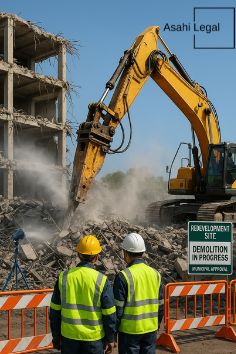
𝐃𝐞𝐦𝐨𝐥𝐢𝐭𝐢𝐨𝐧 𝐨𝐟 𝐁𝐮𝐢𝐥𝐝𝐢𝐧𝐠 𝐮𝐧𝐝𝐞𝐫 𝐑𝐞𝐝𝐞𝐯𝐞𝐥𝐨𝐩𝐦𝐞𝐧𝐭: 𝐋𝐞𝐠𝐚𝐥 𝐏𝐫𝐨𝐜𝐞𝐬𝐬, 𝐑𝐢𝐠𝐡𝐭𝐬, 𝐚𝐧𝐝 𝐒𝐚𝐟𝐞𝐠𝐮𝐚𝐫𝐝𝐬 𝐟𝐨𝐫 𝐇𝐨𝐮𝐬𝐢𝐧𝐠 𝐒𝐨𝐜𝐢𝐞𝐭𝐢𝐞𝐬 & 𝐃𝐞𝐯𝐞𝐥𝐨𝐩𝐞𝐫𝐬 𝐢𝐧 𝐈𝐧𝐝𝐢𝐚
Redevelopment has emerged as one of the most significant urban transformation processes across India, particularly in metropolitan cities such as Mumbai, Thane, Pune, and Navi Mumbai. Ageing buildings, growing population needs, and modern planning regulations have collectively made redevelopment not merely a real estate option but often a structural necessity. One of the most critical and sensitive stages in any redevelopment project is the demolition of the existing structure, a step that triggers several legal consequences, statutory obligations, and rights for both housing societies and developers.
At Asahi Legal, we frequently advise co-operative housing societies, flat purchasers, developers, and landowners on the legal, technical, and procedural framework governing building demolition under redevelopment. Because demolition is irreversible, the law attaches strict procedures to ensure transparency, structural safety, and the protection of rights of all stakeholders. This blog aims to provide a comprehensive, legally-accurate, and easy-to-understand guide on how demolition is legally carried out, what permissions are mandatory, and how societies can safeguard themselves throughout the process.
This article is written in a manner accessible to homeowners, society office bearers, law students, and practising advocates who wish to understand this area of development law from a practical and compliance-driven perspective.
Understanding Why Demolition Becomes Necessary During Redevelopment
Under urban development norms, several structures in cities like Mumbai and Pune are over 30 to 50 years old. These buildings were constructed under earlier planning regulations and are often unable to sustain current population density or structural stress. Over time, buildings may be declared dilapidated, dangerous, or unsafe by the Municipal Corporation, leading to mandatory redevelopment or repairs.
Demolition becomes necessary under the following circumstances:
- When the building is structurally unstable or classified as a C1 building, requiring immediate evacuation.
- When a co-operative society passes a resolution for redevelopment by the legally required majority.
- When technical reports from licensed structural auditors recommend reconstruction rather than repairs.
- When redevelopment creates better urban planning outcomes—such as additional FSI, amenities, and modern building standards.
Demolition is therefore a function of both structural necessity and legal compliance, and is not merely a commercial choice made by the developer.
Legal Framework Governing Demolition Under Redevelopment
Demolition activities fall under a cluster of statutory provisions drawn from municipal law, co-operative laws, building codes, environmental regulations, and general civil and criminal law. The important regulatory pillars include:
- Maharashtra Co-operative Societies Act, 1960 (for decision-making within societies)
- Development Control & Promotion Regulations (DCPR 2034) or applicable local DCPRs
- Municipal Corporation Act / MMC Act / PMC Act (for demolition permissions)
- Environmental Protection Act & Construction Waste Rules
- Maharashtra Regional Town Planning Act (MRTP Act)
- Bombay High Court guidelines on redevelopment and demolition safety
At Asahi Legal, we carefully review the compliance of each of these laws when representing a housing society or developer, because even one missing permission can expose the project to injunctions, complaints, or criminal liability.
Mandatory Permissions Required Before Demolition
Before the first hammer strikes the structure, the developer and society must ensure that every legal formality has been completed. Demolition without permissions is treated as an unauthorised act punishable under the MRTP Act, municipal laws, and even criminal law if any injury or death occurs.
The following permissions are indispensable:
1. Demolition Permission from the Municipal Corporation
Every municipal body has a prescribed form and application process. The developer must submit:
- approved redevelopment plans,
- structural audit reports,
- list of existing occupants,
- consent letters,
- method statement for demolition, and
- debris management plan.
Only after scrutiny is the Demolition Order issued by the designated municipal officer.
2. Intimation of Disapproval (IOD) & Commencement Certificate (CC)
Under DCPR 2034, the IOD sets out the conditions that must be fulfilled before redevelopment begins. Some corporations allow demolition only after the CC is issued; others permit demolition upon fulfilling IOD conditions. Compliance with these conditions is vital.
3. Safety Permissions & Precautions
These include:
- barricading permissions
- traffic and police NOC (if the demolition affects public movement)
- utility disconnection (electricity, water, gas)
If any utility remains active during demolition, it creates major safety risks. Municipal corporations strictly monitor compliance.
4. Consent from Occupants
Under redevelopment guidelines and co-operative laws, the society must secure consent from members by majority and execute a development agreement with the developer. Without proper consent, demolition can be challenged.
5. Temporary Accommodation & Rents
The developer must provide transit accommodation or rent to all eligible members before demolition begins. Courts have repeatedly emphasised this obligation as non-negotiable.
Role of the Co-operative Housing Society in Approving Demolition
Housing societies are not passive participants in redevelopment. They are statutory bodies that must undertake due diligence, protect member interests, and approve demolition only after ensuring the following:
- Proper appointment of a developer through a transparent tender process.
- Execution of the redevelopment agreement.
- Verification that the developer has obtained all statutory approvals.
- Confirmation that transit rent or alternate accommodation is provided.
- Appointment of a project management consultant (PMC) to monitor the process.
Failure to follow the correct procedure may result in police complaints, civil suits, or members challenging the demolition.
Rights of Flat Owners During Demolition and Redevelopment
Flat purchasers and society members possess strong statutory rights during the redevelopment process. These include:
1. Right to Safe Evacuation and Transit Accommodation
Members are entitled to safe evacuation, shifting support, and either rent or transit accommodation.
2. Right to Transparency
Societies must share copies of:
- agreements
- approved plans
- permissions
- timelines
Transparency prevents disputes and ensures members remain informed.
3. Right to Re-entry in Redeveloped Building
Developers must ensure that every eligible member receives a permanent alternate accommodation agreement (PAAA) guaranteeing their right to the new flat.
4. Right to Challenge Illegal Demolition
If demolition begins without proper permissions or safety precautions, members may file:
- a police complaint,
- a complaint with the corporation,
- a civil injunction,
- or a complaint under the co-operative court.
At Asahi Legal, we routinely challenge unlawful demolitions and also defend societies when demolition is delayed due to frivolous objections.
Obligations of the Developer Before and After Demolition
Developers have statutory, contractual, and fiduciary obligations during redevelopment. These obligations include:
- obtaining all necessary permissions,
- providing fair and timely rent,
- ensuring safety measures at the demolition site,
- managing debris disposal as per environmental norms,
- commencing construction within committed timelines, and
- keeping the society updated.
Any breach may allow the society to terminate the development agreement and appoint a new developer.
Demolition Methodology & Safety Regulations
Demolition is a complex engineering activity requiring professional execution. The law requires the developer to appoint qualified demolition contractors and submit a method statement describing:
- demolition sequence,
- machinery used,
- risk mitigation steps,
- debris disposal plan, and
- safety protocol for adjacent buildings.
Contractors must comply with:
- BIS safety standards,
- Municipal guidelines,
- Pollution control norms, and
- Labour law requirements.
If any injury or fatality occurs due to negligence, the developer may face criminal prosecution, making safety compliance essential.
Legal Disputes Commonly Arising During Demolition
Demolition-related litigation has increased significantly. Common disputes include:
- dissenting members refusing to vacate,
- allegations of inadequate rent,
- challenges to developer appointment,
- objections that permissions are incomplete,
- stay orders affecting demolition timelines, and
- disputes between developer and contractor.
At Asahi Legal, our redevelopment litigation team appears before the Co-operative Court, Civil Court, DCPR authorities, NCLT (where insolvency overlaps redevelopment), and the Bombay High Court on redevelopment issues.
Environmental Compliance During Demolition
As per the Construction & Demolition Waste Rules, developers must:
- segregate waste
- transport debris only through authorised vehicles
- avoid dust pollution through sprinkling systems
- follow noise pollution guidelines
- maintain debris disposal records
Non-compliance attracts penalties and suspension of demolition permissions.
Demolition of a Dangerous or Dilapidated (C1) Building
When a building is classified as C1 (dangerous), residents are legally required to vacate the premises. If they resist, the municipal corporation can forcibly evict occupants in public interest.
In such cases, demolition becomes mandatory and is guided by:
- structural audit reports,
- court precedents, and
- municipal urgency powers.
Societies must ensure that the developer is ready to begin construction immediately after demolition to prevent further delay.
Case Study: What Typically Goes Wrong in Demolition (and How Asahi Legal Resolves It)
While every matter is unique, the most common failures that derail redevelopment include:
- lack of proper documentation,
- demolition without CC/IOD compliance,
- disputes over rent or area entitlement,
- high-handedness by either developer or members,
- absence of liaison follow-up for permissions,
- criminal complaints lodged by dissenting members.
Asahi Legal’s redevelopment team resolves such disputes by conducting a detailed audit of the documents, identifying statutory breaches, bringing the matter before the appropriate forum, and ensuring that the project gets back on track in a legally-compliant manner.
Conclusion: Demolition Is the Turning Point of RedevelopmenLegal Compliance Ensures a Smooth Transition
Demolition marks the transition between the old and the new. It represents the end of structural risk but also the beginning of opportunity. However, this phase carries high legal sensitivity and must be handled with precision, caution, and transparency.
Whether you are a society office bearer, a homeowner, or a developer, the demolition phase requires experienced legal hand-holding to ensure that every compliance is met, every permission is in place, and every member’s right is protected.
At Asahi Legal, we take pride in assisting societies across Maharashtra in ensuring that their redevelopment process is not only legally robust but also structurally and commercially sound.
📞 Need Legal Support for Demolition or Redevelopment?
If your society is planning redevelopment or facing challenges related to demolition permissions, developer disputes, or member objections, Asahi Legal is equipped to guide you through every step.
📩 Contact us today for a consultation. Our team will be pleased to assist you with the complete redevelopment lifecycle from resolution stage to demolition to final handover.
This article is for general information only and is not legal advice or an invitation to engage the firm. Laws and judgments change; please obtain specific legal advice before acting.