

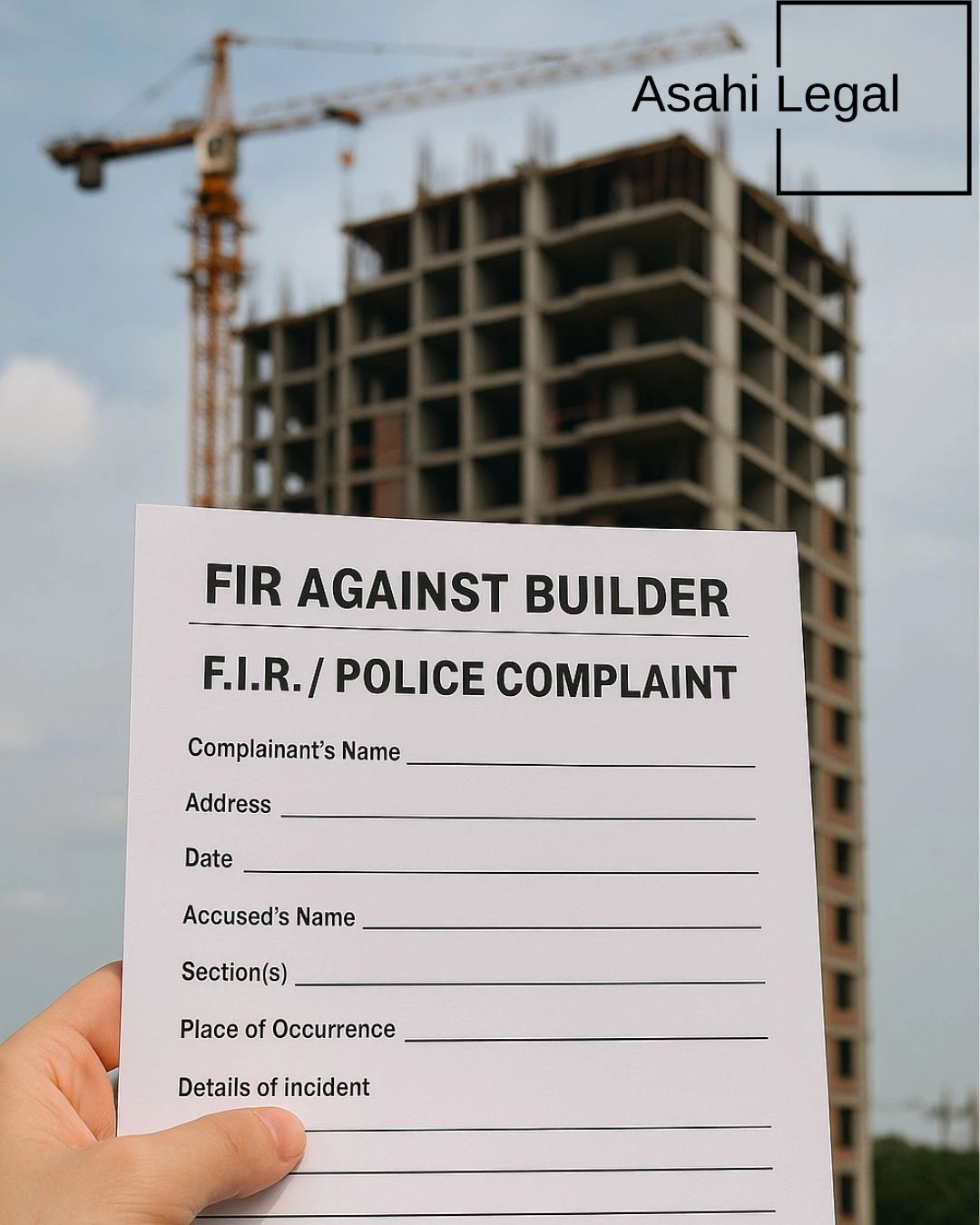
File FIR Against Builder if Cheated – A Legal Guide for Homebuyers in Maharashtra.
By Asahi Legal LLP – Advocates & Legal Consultants, Mumbai
Introduction
Buying a home is one of the most important milestones in one’s life. For most families, it is not just a financial decision but an emotional one, tied to security, stability, and legacy. Yet, the real estate sector has often been plagued by instances where builders mislead, delay, or outright cheat homebuyers. Delayed possession, unapproved plans, diversion of funds, and unfulfilled promises are unfortunately common stories.
To strengthen consumer protection, the Maharashtra Police have clarified that if a builder indulges in fraudulent or dishonest conduct, a First Information Report (FIR) can and should be filed. This recognition underscores that homebuyers are not powerless and can invoke both civil and criminal law remedies.
At Asahi Legal, we assist homebuyers, cooperative housing societies, and residents’ associations in safeguarding their rights against unscrupulous builders. This blog explains, in simple but legally accurate terms, how and when to file an FIR against a builder, what provisions of law apply under the new criminal laws (BNS & BNSS, 2023), and what steps you should take if you have been cheated.
Understanding Cheating by Builders
Cheating in the real estate sector may not always appear blatant. It may take many subtle forms, such as:
- Promising possession of flats within a stipulated timeline but failing to deliver for years.
- Launching projects without mandatory municipal or environmental approvals.
- Misrepresenting the actual carpet area or facilities promised.
- Allotting or selling the same flat to multiple buyers.
- Collecting advances for construction but diverting funds elsewhere.
These acts are not merely breaches of contract. If carried out with dishonest intent, they amount to criminal offences under the Bharatiya Nyaya Sanhita, 2023 (BNS).
Legal Provisions Applicable under the New Laws
- Section 316 BNS – Criminal Breach of Trust When a builder accepts money for a specific purpose—such as completing construction or handing over possession—but misuses or diverts those funds, the act falls within criminal breach of trust.
- Section 318 BNS – Cheating and Dishonestly Inducing Delivery of Property One of the most invoked provisions against fraudulent developers, this section applies where builders induce buyers to part with money based on false promises or misrepresentations.
- Sections 336 & 338 BNS – Forgery and Use of Forged Documents If a builder relies on fabricated approvals, manipulated NOCs, or falsified land records to secure investments, these provisions impose liability for forgery.
- Maharashtra Ownership of Flats Act, 1963 (MOFA) and Real Estate (Regulation and Development) Act, 2016 (RERA) These special statutes mandate transparency, disclosures, and obligations for builders. Breaches of MOFA or RERA can attract civil consequences as well as criminal action under BNS.
FIR Against Builder – Maharashtra Police’s Stand
The stand taken by the Maharashtra Police is significant. They have confirmed that if a complaint discloses elements of cheating or fraud, it cannot be dismissed as a “mere civil dispute.” An FIR should be registered if the facts suggest offences like cheating under Section 318 BNS or criminal breach of trust under Section 316 BNS.
This is important because builders often defend themselves by calling delays or defaults “contractual issues.” The police clarification ensures that fraudulent conduct with dishonest intent is squarely treated as a criminal offence.
Filing an FIR – Step-by-Step Process
- Collect Documentation Preserve agreements for sale, allotment letters, payment receipts, marketing brochures, and correspondence with the builder. These documents help prove misrepresentation.
- Approach the Police Station Submit a written complaint narrating the sequence of events. Where cognizable offences like cheating are disclosed, the police are bound to register an FIR.
- Escalation if FIR is Refused
- Under Section 173 BNSS, 2023, a complainant may approach the Superintendent of Police if the local station refuses to act.
- Alternatively, under Section 175 BNSS, 2023 (earlier Section 156(3) CrPC), a complaint may be filed before the Magistrate, who can direct registration of an FIR.
- Parallel Remedies While pursuing criminal action, buyers may also:
- Approach the Consumer Commissions for deficiency of service.
- File complaints before RERA for possession, refund, or compensation.
- Institute civil recovery suits for damages.
Challenges Faced by Homebuyers
- Civil vs Criminal Argument: Builders often argue that non-delivery is a contractual matter. However, courts emphasize that dishonest inducement and fraud go beyond civil disputes.
- Reluctance of Police: Practical difficulties arise where local police are hesitant to act against powerful developers. Legal intervention becomes necessary.
- Multiple Proceedings: Homebuyers sometimes juggle proceedings in RERA, consumer forums, civil courts, and criminal courts simultaneously. Proper legal strategy is key to efficiency.
Judicial Approach
Courts have consistently distinguished between a simple breach of contract and acts of fraudulent inducement. For instance, if a builder collects money knowing that approvals do not exist, the courts consider it cheating under criminal law.
At the same time, courts are mindful of preventing misuse of criminal proceedings for purely contractual defaults. The guiding principle is whether the dishonest intent existed at the very inception of the transaction.
RERA vs FIR – Complementary Remedies
A common doubt among homebuyers is whether to file a case under RERA or with the police. The correct answer is: both can be pursued together, depending on the relief sought.
- RERA deals with possession, compensation, and compliance with project timelines.
- FIR ensures that the criminal misconduct of the builder is penalized.
Together, these provide a comprehensive remedy.
Why Filing an FIR is a Strong Remedy
- It creates immediate accountability for the builder.
- It prevents further cheating of unsuspecting buyers.
- It can lead to arrest, interrogation, or restrictions on the builder’s movement.
- It strengthens the complainant’s bargaining position in eventual settlement discussions.
Practical Advice from Asahi Legal
At Asahi Legal LLP, we recommend the following steps for homebuyers and housing societies:
- Always conduct due diligence on approvals, land titles, and the builder’s track record before investing.
- Avoid relying solely on promotional material—cross-check approvals with municipal and planning authorities.
- If cheating or fraud is suspected, seek legal consultation early. Time is crucial in preventing larger financial loss.
- Adopt a multi-pronged approach: RERA for regulatory relief, consumer forums for service deficiency, civil suits for monetary recovery, and FIR for criminal accountability.
Case Study: Redevelopment Projects
In Maharashtra, cooperative housing societies often enter into redevelopment agreements with developers. While promises of larger flats and higher corpus funds appear attractive, many projects stall midway or the builder defaults on commitments.
When societies face such betrayal, they should not restrict themselves to civil remedies alone. Filing an FIR under the BNS provisions for cheating and breach of trust can be a powerful tool to hold developers accountable.
Conclusion
The message is unambiguous: if a builder cheats, homebuyers are entitled to file an FIR under the Bharatiya Nyaya Sanhita, 2023. The Maharashtra Police’s clarification affirms that fraudulent practices in real estate are criminal in nature and cannot be brushed aside as mere civil disputes.
However, the interplay of remedies RERA, consumer forums, civil suits, and criminal law requires careful navigation. At Asahi Legal LLP, our expertise lies in designing holistic strategies that protect the rights of homebuyers and societies at every step.
Call to Action
If you or your society have been deceived by a builder—whether in a home purchase, redevelopment, or property transaction do not hesitate to act. Contact Asahi Legal LLP today. Our experienced team in Mumbai will guide you through filing an FIR, pursuing remedies under RERA, and recovering your rightful dues.
📞 Call us at +91-96197 92277 📧 Email: office@asahilegal.in 🌐 Visit: www.asahilegal.in
This article is for general information only and is not legal advice or an invitation to engage the firm. Laws and judgments change; please obtain specific legal advice before acting.