

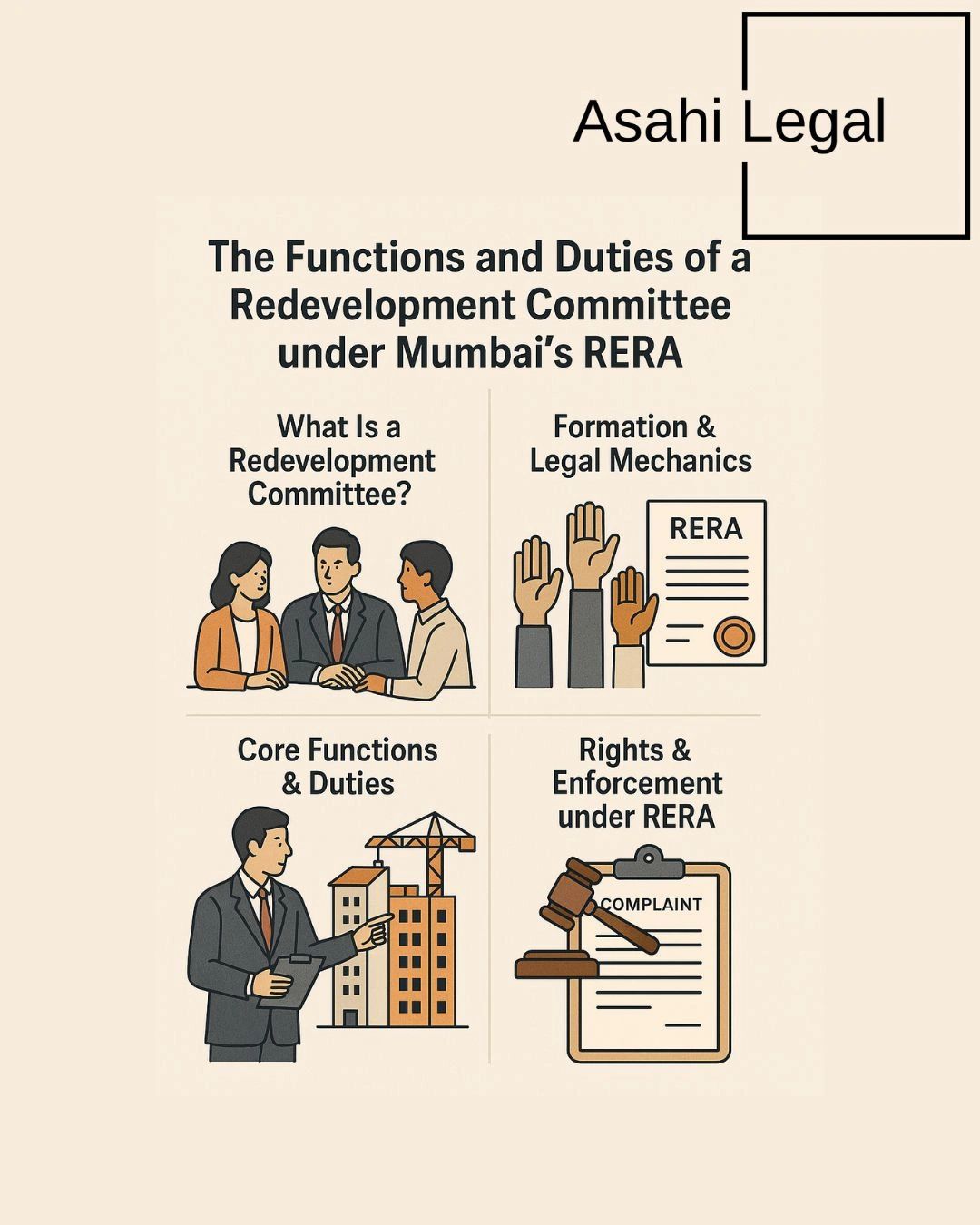
The Functions and Duties of a Redevelopment Committee under Mumbai’s RERA
A complete legal guide by Asahi Legal
As Mumbai witnesses an ongoing wave of urban renewal, the need for redevelopment of older housing societies has become a pressing reality. This growth, however, brings with it challenges related to transparency, delays, and the protection of flat owners’ rights. To address these concerns, the Real Estate (Regulation and Development) Act, 2016 (RERA) plays a vital role in regulating redevelopment projects across Maharashtra. At the heart of this process lies a key regulatory mechanism—the Redevelopment Committee. At Asahi Legal, we understand the critical importance of these committees in ensuring that redevelopment is executed transparently, equitably, and within the legal framework. This article explores the structure, responsibilities, and legal powers of Redevelopment Committees under Mumbai’s RERA, along with practical insights and best practices drawn from real-world experience.
What Is a Redevelopment Committee?
A Redevelopment Committee, often referred to as a Consent Committee or Owners’ Association, is a body formed within a cooperative housing society to represent the collective interests of flat owners during the redevelopment process. This committee is typically elected and authorized to make decisions on behalf of the society’s members. Within the framework of RERA, it serves not only as a liaison with the developer but also as a statutory safeguard to ensure that the interests of homeowners are not compromised. The legal standing of the Redevelopment Committee makes it one of the most essential components of any society-led redevelopment project in Mumbai.
Formation & Legal Mechanics
The legal process of forming a Redevelopment Committee begins once a significant majority of the society’s members—generally 60% by number or area—agree to proceed with redevelopment. A general meeting is called, and members are elected to the committee, usually comprising a chairperson, secretary, treasurer, and additional members as required based on the size of the society. Once elected, the committee’s composition and roles are formalized through documentation that becomes part of the society’s redevelopment records.
This newly formed committee is then included in the RERA application submitted for project registration. Upon approval, the members’ names are officially recorded on the RERA certificate. This registration gives the committee formal recognition, enabling it to legally engage with developers, consultants, and authorities throughout the redevelopment lifecycle.
The committee’s role does not end with initial planning. It continues to function throughout the project duration—from conceptualization, plan approval, and construction supervision to final possession and handover. The committee’s responsibilities persist until occupation certificates are received, ensuring there is oversight at every crucial stage of redevelopment.
Core Functions & Duties
The functions of a Redevelopment Committee are multifaceted and go far beyond merely signing papers or coordinating meetings. One of its fundamental responsibilities is to uphold transparency throughout the redevelopment process. This includes monitoring the project’s schedule, ensuring compliance with approved construction milestones, and reviewing any deviations from sanctioned architectural or structural plans. The committee is expected to actively engage with the developer and share accurate, up-to-date information with all society members, thus upholding the transparency mandates set forth under RERA.
Another key function is financial oversight. As per RERA regulations, developers are obligated to deposit a majority of collected funds—typically 70%—into a designated escrow account. The Redevelopment Committee is entrusted with the responsibility of ensuring that these funds are used strictly for construction and project-related expenses. They are entitled to review financial statements, scrutinize developer billings, and even demand audits in case of discrepancies. At Asahi Legal, we frequently assist committees in setting up robust systems for financial reporting and escrow management to ensure that no funds are misused.
Communication and grievance management also fall squarely within the committee’s scope. The committee acts as a bridge between the flat owners and the developer. It is expected to hold regular meetings where updates about the project are shared, architectural or quality-related changes are communicated, and residents’ grievances are heard and resolved. Where resolution cannot be achieved amicably, the committee has the authority to escalate matters formally to the RERA authority.
A legal cornerstone of redevelopment is owner consent. Before any formal agreement with a developer can be executed, RERA requires that at least 70% of the society’s members approve the redevelopment. The Redevelopment Committee manages this process by issuing notices, organizing voting mechanisms, and collecting notarized consent forms. Proper documentation of this consent is crucial and often forms the basis of legal protection in case of future disputes.
Once redevelopment plans are submitted, the committee has the legal authority to approve or reject layouts, elevations, and building specifications. This includes reviewing floor plans, unit configurations, material specifications, and the positioning of shared amenities such as lifts, parking spaces, and green zones. Their approval becomes legally binding once the project is registered with RERA, which makes their role not just advisory but decisively regulatory.
Supervision during construction is another vital duty. Committee members often collaborate with independent engineers or third-party experts to assess the quality of materials used, such as cement, steel reinforcements, and waterproofing systems. They also ensure adherence to safety protocols and approved designs. In case of substandard work, the committee is authorized to demand remedial action from the developer and can even approach RERA for intervention.
Enforcing project timelines is a critical function that cannot be overlooked. The committee is expected to monitor key stages of construction such as foundation work, floor slab casting, and plastering. If delays occur, they can invoke provisions under RERA to seek penalties, interim relief, or revised delivery commitments from the developer.
Rights & Enforcement under RERA
RERA grants a wide range of rights to Redevelopment Committees, empowering them to protect homeowners’ interests in legally enforceable ways. Under Section 18 of the Act, for example, committees can file formal complaints if the developer fails to deliver possession on time, delivers substandard construction, or misuses escrow funds. They can seek interest compensation, project correction orders, or even cancellation of registration in serious cases.
Committees are also entitled to seek interim relief through the RERA Authority, especially in situations where the project is stalled or developers become uncooperative. In such cases, they may request injunctions or legal directions compelling the developer to comply with agreed terms.
In terms of public accountability, RERA empowers the committee to ensure that the developer shares regular updates through RERA’s public disclosure portal. This keeps homeowners informed and builds trust in the process, reducing the likelihood of disputes and litigation.
Real-World Scenario: Greenwood Society
To better understand the impact of a proactive committee, consider the hypothetical case of Greenwood Society, a 50-flat housing cooperative in suburban Mumbai. Shortly after receiving initial consent, the committee was elected within three weeks and immediately began its review of the proposed redevelopment plans. The committee identified concerns with the developer’s floor area ratio (FAR) projections and successfully negotiated changes, reducing the FAR from 2.5 to 2.2 to maintain better structural integrity.
As construction began, they insisted on a pre-excavation structural audit, which revealed weak soil conditions that required design adjustments. During construction, the developer attempted to use substandard plaster materials, which the committee flagged and rejected. When plastering work was delayed by more than six months, the committee filed a complaint with MahaRERA. The regulator ruled in their favor, awarding 9% interest compensation for the delay.
Guided by Asahi Legal throughout the process, Greenwood Society’s committee ensured that the redevelopment was not only legally compliant but also delivered on time, with quality materials and fair financial compensation. This example demonstrates how empowered and informed Redevelopment Committees can fundamentally shape the success of redevelopment.
Challenges & Committee Best Practices
Despite their legal authority, Redevelopment Committees often face several challenges. Lack of timely documentation from the developer, pressure during elections, limited access to financial records, and non-compliance with construction timelines can all hinder smooth operations. Additionally, internal conflicts among residents can slow decision-making and reduce effectiveness.
To overcome these challenges, it is essential that committee members undergo training and attend legal briefings. Engaging experts such as legal advisors, architects, and certified structural auditors provides much-needed professional insight. Consistent documentation of minutes, resolutions, and official communication protects the committee from future legal disputes. Transparent communication, including newsletters and digital updates, fosters community trust. Lastly, asserting legal rights under RERA at the earliest sign of non-compliance often results in quicker, more favorable resolutions.
Why Choose Asahi Legal?
Asahi Legal is among Mumbai’s leading law firms in redevelopment and RERA-related advisory. We specialize in helping societies form legally sound Redevelopment Committees and provide end-to-end guidance throughout the redevelopment journey. Our team of experts ensures that consent procedures are watertight, agreements are fair, and society members are fully informed. We conduct legal and financial audits, supervise documentation, represent committees before the RERA Authority, and act as ongoing legal counsel to minimize risks and maximize homeowner protection.
Our proactive, solution-focused approach allows housing societies to navigate the complex legal and regulatory landscape with confidence. Whether your society is just beginning to consider redevelopment or is already in the middle of the process, Asahi Legal is equipped to step in and offer strategic legal solutions tailored to your needs.
Conclusion & Call to Action
In the ever-changing urban fabric of Mumbai, redevelopment is not merely about upgrading homes—it is about securing the future of entire communities. The Redevelopment Committee is central to this mission. With the right guidance, legal backing, and proactive oversight, these committees can ensure that redevelopment is not just efficient, but also equitable, transparent, and aligned.
This article is for general information only and is not legal advice or an invitation to engage the firm. Laws and judgments change; please obtain specific legal advice before acting.