

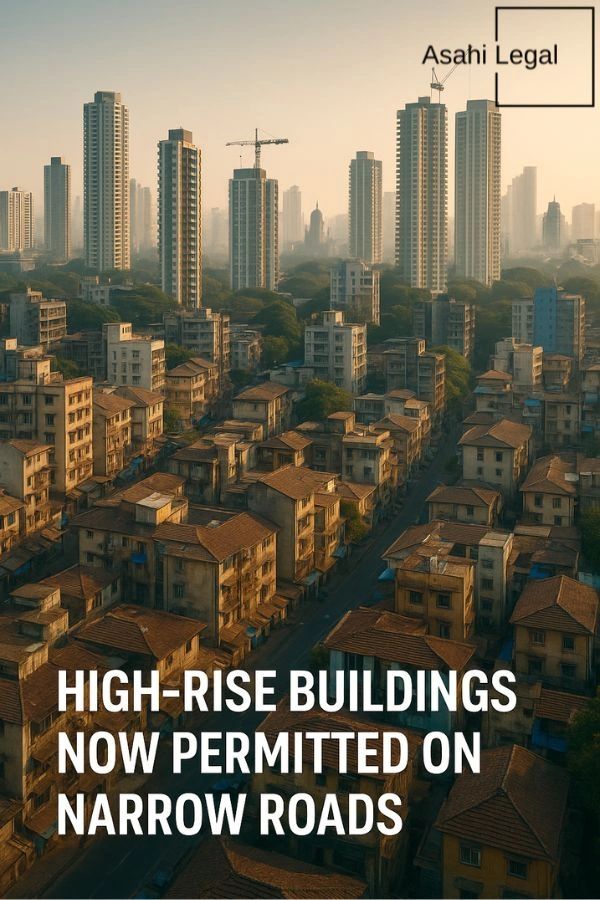
High-Rise Buildings Now Permitted on Narrow Roads: A
Game- Changer for Mumbai’s Redevelopment Landscape
Urban redevelopment in Mumbai has always been guided by a delicate balance between safety, space, and sustainability. One of the long-standing challenges faced by cooperative housing societies and developers alike was the restriction on constructing high-rise buildings along narrow access roads. The Development Control and Promotion Regulations (DCPR) 2034, which came into force in September 2018, had tightly linked the permissible height and Floor Space Index (FSI) of a building to the width of the adjoining road. However, recent policy updates have relaxed these limitations, paving the way for more feasible redevelopment of small and irregular plots across the city.
This reform marks a significant milestone for housing societies and property owners seeking to revitalize aging structures — a matter of particular relevance to Mumbai’s vast stock of pre-1980s buildings. At Asahi Legal LLP, our real-estate and redevelopment team has closely studied these policy changes and their implications for societies, developers, and co-developers planning new projects.
Background: The Earlier Restrictions under DCPR 2034
Under the earlier DCPR 2034 framework, redevelopment projects on roads narrower than nine metres were largely non-viable. The regulations disallowed loading of Transferable Development Rights (TDR) on such plots and capped FSI benefits depending on the road width. For example:
- Buildings on 9-metre roads in the island city were entitled to only 1.33 FSI, down from 1.5 FSI under the old DCR 1991.
- In suburban areas, the FSI was reduced from 2.0 to 1.0.
- For roads between 9 and 12.2 metres, only 2.0 FSI was allowed.
As a result, several redevelopment proposals remained stalled, especially those situated on small internal roads — even when the existing buildings were in a dangerous or dilapidated condition.
The New Policy: Opening Doors for Taller Redevelopments
Recognising the need for urban renewal and safer housing, the Municipal Corporation of Greater Mumbai (MCGM) has now adopted a progressive approach. As per the Circular No. Ch.Engg./DP/3310/Gen. dated 31 July 2020, residential buildings of over 32 metres (approximately 10 storeys) are now permitted even on plots having a frontage narrower than 9 metres, provided that they abut a public road of at least 9 metres in width.
This means that even if the access to a plot is limited — for example, a 6-metre or 7-metre lane opening into a wider public road — redevelopment can still proceed, subject to compliance with stringent fire-safety and planning conditions.
The full FSI of 2.0, earlier restricted to 9-metre-wide frontages, may now also be granted to such qualifying plots. This policy particularly benefits smaller societies and standalone buildings in the suburbs, where narrow roads had previously made redevelopment unfeasible.
Fire Safety and Structural Requirements
Given the inherent risks of constructing taller buildings on narrow roads, the new circular has introduced detailed fire-safety parameters based on building height:
1. For buildings up to 15 metres (approximately 5 storeys):
- Minimum 3.6-metre-wide approach and open space alignment.
- Adequate firefighting installations, including hydrants, hose reels, overhead water tanks, and manual fire-alarm systems.
- Mandatory appointment of a Government-licensed fire-safety agency under the Maharashtra Fire Prevention and Life Safety Measures Act, 2006.
2. For buildings between 15 and 32 metres (approximately 10 storeys):
- At least two lifts, including one fireman evacuation lift.
- Underground and overhead water tanks of 50,000 and 20,000 litres respectively.
- Automatic sprinkler systems in all habitable rooms and lift lobbies.
- Fire-resistant doors, enclosed staircases, and clearly demarcated evacuation routes.
- Ongoing certification and annual maintenance obligations from licensed agencies.
For buildings taller than 32 metres, the MCGM’s Fire Department will continue to examine proposals on a case-by-case basis, ensuring that access and staging areas are adequate.
Implications for Redevelopment Projects
This reform has far-reaching consequences for cooperative housing societies, developers, and architects in Mumbai. It removes a critical bottleneck that had rendered thousands of small plots non-developable under the previous regime. The new framework enables:
- Smaller societies located on narrow internal roads to undertake redevelopment independently.
- Enhanced FSI utilization, allowing economically viable projects even on compact plots.
- Revival of stalled projects, where earlier sanctions were denied due to inadequate road width.
- Improved safety compliance, aligning with modern firefighting and evacuation standards.
At Asahi Legal LLP, our redevelopment advisory practice assists housing societies from the concept stage to completion — including drafting of development agreements, reviewing project feasibility, and ensuring adherence to new planning norms under DCPR 2034 and related BMC circulars.
Expert Perspective: Why This Matters
Mumbai’s urban fabric is characterized by narrow lanes and fragmented plot layouts. For decades, these limitations prevented smaller buildings from accessing the benefits of modern redevelopment. By permitting high-rise structures on narrow roads, subject to enhanced fire-safety protocols, the BMC has provided much-needed flexibility.
This change will not only boost self-redevelopment initiatives but also empower cooperative societies to partner with credible co-developers without being constrained by outdated spatial rules. Legal advisors, architects, and planners now have a clearer framework to guide clients through the process.
Legal and Compliance Considerations
Societies embarking on redevelopment under this relaxed regime must still comply with:
- All fire-safety certifications and annual reporting under the Maharashtra Fire Prevention and Life Safety Measures Act, 2006.
- Sanctioned building plans approved through the AutoDCR system.
- Society resolution and consent procedures as per Section 79(A) of the Maharashtra Co-operative Societies Act, 1960.
- Registration of Development Agreements in accordance with the Registration Act, 1908, and attachment of requisite documents such as title reports, NA permissions, and TDR utilization statements.
At Asahi Legal, our team ensures that every redevelopment project remains fully compliant while protecting the rights of society members through well-drafted contractual documentation and due-diligence checks.
Conclusion: A Step Forward for Urban Renewal
The relaxation of height and FSI restrictions on narrow roads is a progressive step toward balanced urban regeneration. It ensures that Mumbai’s smaller plots and single-building societies are not left behind in the redevelopment wave sweeping across the metropolis. With strong fire-safety measures and transparent legal frameworks, this policy enables safe vertical growth without compromising accessibility or public safety.
🔹 Need Legal Guidance for Redevelopment?
If your housing society or developer consortium wishes to understand how this new policy can benefit your project, connect with Asahi Legal LLP, Mumbai’s leading law firm specializing in redevelopment, cooperative housing law, and real-estate compliance.
📞 Visit www.asahilegal.in or schedule a consultation with our redevelopment advisory team today.
This article is for general information only and is not legal advice or an invitation to engage the firm. Laws and judgments change; please obtain specific legal advice before acting.