

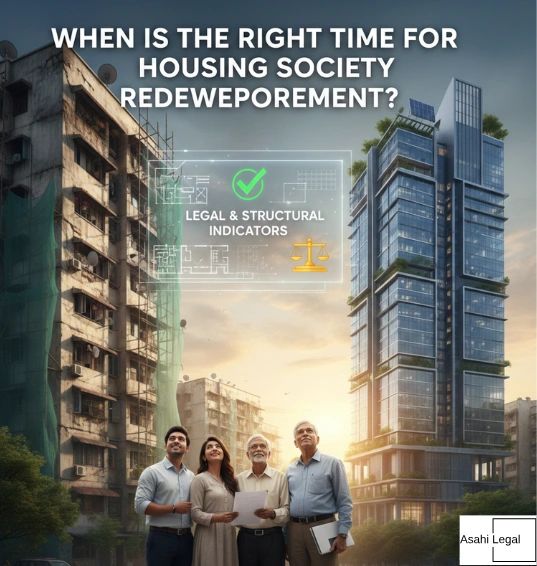
The “Expiry Date” of Your Home
We all love our homes, but let’s be honest: buildings, like cars, have an expiry date. Maybe the elevators are constantly “Under Repair,” the overhead tanks are leaking into your bedroom ceiling, or the “modern” amenities from 1985 just aren’t cutting it anymore.
In India, Redevelopment is the ultimate upgrade. It’s when a society decides to pull down the old building and let a developer build a shiny new one. In exchange for the land, you usually get a bigger flat, brand-new amenities, and a “Corpus Fund” (a nice chunk of cash).
But wait—before you start packing your bags, there’s a legal mountain to climb. At Asahi Legal LLP, we’ve seen societies sail through this and others get stuck in court for a decade. Here is the “Golden Checklist” to know if your society is truly ready for a fresh start.
1. The “ID Card” Check: Who Owns the Land?
Imagine trying to sell a car that is still legally in your uncle’s name. You can’t, right? The same applies to your society.
The Simple Truth
In many Indian societies, the building belongs to the members, but the land is still in the name of the original builder or the government. To redevelop, the land must be legally transferred to the Society. This is called Conveyance.
Why It’s Critical
Without a “Deed of Conveyance,” you aren’t the legal owners of the plot. No municipal body will give you permission to build, and no bank will give the developer a loan.
Practical Checklist
- Does the Society have the Original Sale Deed?
- Is the Property Card or 7/12 Extract in the Society’s name?
- If the builder hasn’t transferred the land, have you applied for Deemed Conveyance?
The Common Trap: “But we’ve lived here for 40 years!” Living there doesn’t mean owning the land. Always check the paperwork first.
2. The “Safety First” Check: Is the Building Tired?
You can’t just redevelop because you want a bigger balcony. There needs to be a structural reason.
The Simple Truth
Across India, buildings over 30 years old are generally considered “seniors.” However, if your building is younger but falling apart, you need a professional to say so.
Why It’s Critical
A Structural Audit by a government-approved engineer is your “Medical Certificate.” It proves to the authorities that the building is either unsafe or too expensive to repair.
Practical Checklist
- Has an engineer checked the “health” of your pillars and beams?
- Are repair costs higher than 30% of what it would cost to build new?
- Has the local Municipality issued a “Dilapidated Structure” notice?
3. The “RERA” Shield: Is Your Developer Legit?
The biggest fear in redevelopment? The developer stops halfway, leaving you with no home and no rent money.
The Simple Truth
The RERA (Real Estate Regulatory Authority) is your bodyguard. Every major redevelopment project in India must be registered under RERA.
Why It’s Critical
RERA forces the developer to be transparent. They can’t take your project’s money and use it to buy a private jet or start another project. If they delay, they pay heavy interest to you.
Practical Checklist
- Is the developer financially stable? (Ask for 3 years of balance sheets).
- Will they provide a Bank Guarantee? (This is your insurance policy if they disappear).
- Is there a clear “Rent & Moving” clause in the contract?
4. The “FSI” Math: What’s the Bonus?
Redevelopment works because of FSI (Floor Space Index). Think of FSI as “Permission to Build Up.”
The Simple Truth
If the government increases the FSI for your area, the developer can build more floors. They give you some extra space for free and sell the rest to new buyers to make a profit. That’s the “win-win.”
[Image showing the concept of FSI/FAR in building construction]
Why It’s Critical
You need to know exactly how much “Bonus Space” your plot is worth. If the developer is getting 50% more space but only giving you 10%, you’re getting a bad deal.
Practical Checklist
- Have you hired an independent Project Management Consultant (PMC)?
- Do you know your city’s latest Master Plan rules?
- Is your plot affected by “Road Widening” or “Height Restrictions”?
5. The “Unity” Check: Is Everyone on Board?
One unhappy neighbor can sometimes stop a project of 100 people.
The Simple Truth
You don’t need 100% agreement anymore. In most parts of India, if 51% to 75% of the members agree, the redevelopment can proceed. However, “forced” redevelopment is a recipe for lawsuits.
Why It’s Critical
The law requires a Special General Body Meeting (SGM). If you don’t follow the exact steps (proper notice, recording minutes, inviting a registrar), a dissenting member can take the society to court and freeze the project for years.
Practical Checklist
- Was the meeting notice sent at least 14 days in advance?
- Is the meeting being video-recorded?
- Are the “Dissenting Members” being heard, or just ignored? (Tip: Empathy saves legal fees!)
Don’t Sign Anything Without a Lawyer!
Redevelopment is like a marriage—it’s easy to get into, but very painful to get out of if things go wrong. While a developer’s brochure might look like a dream, the Development Agreement is where the reality lives.
At Asahi Legal LLP, we don’t just “check” papers; we protect your legacy. We ensure that your society’s future is built on a foundation of legal steel.
How We Can Help You:
- Paperwork Detective: We find missing titles and fix “Conveyance” issues.
- The “Bull-Dog” Vetting: We review builder contracts to ensure you have the power to terminate if they delay.
- RERA Smooth-Sailing: We handle all the registrations and compliance.
- Peace Maker: We help resolve disputes between members so the project keeps moving.
Ready to turn that old apartment into a dream home?
Contact Asahi Legal LLP today. Let’s make sure your redevelopment journey is a success story, not a cautionary tale.
Disclaimer: This blog is for informational purposes only and does not constitute legal advice. Property laws are subject to change; always consult with a qualified legal professional for your specific case.
This article is for general information only and is not legal advice or an invitation to engage the firm. Laws and judgments change; please obtain specific legal advice before acting.