

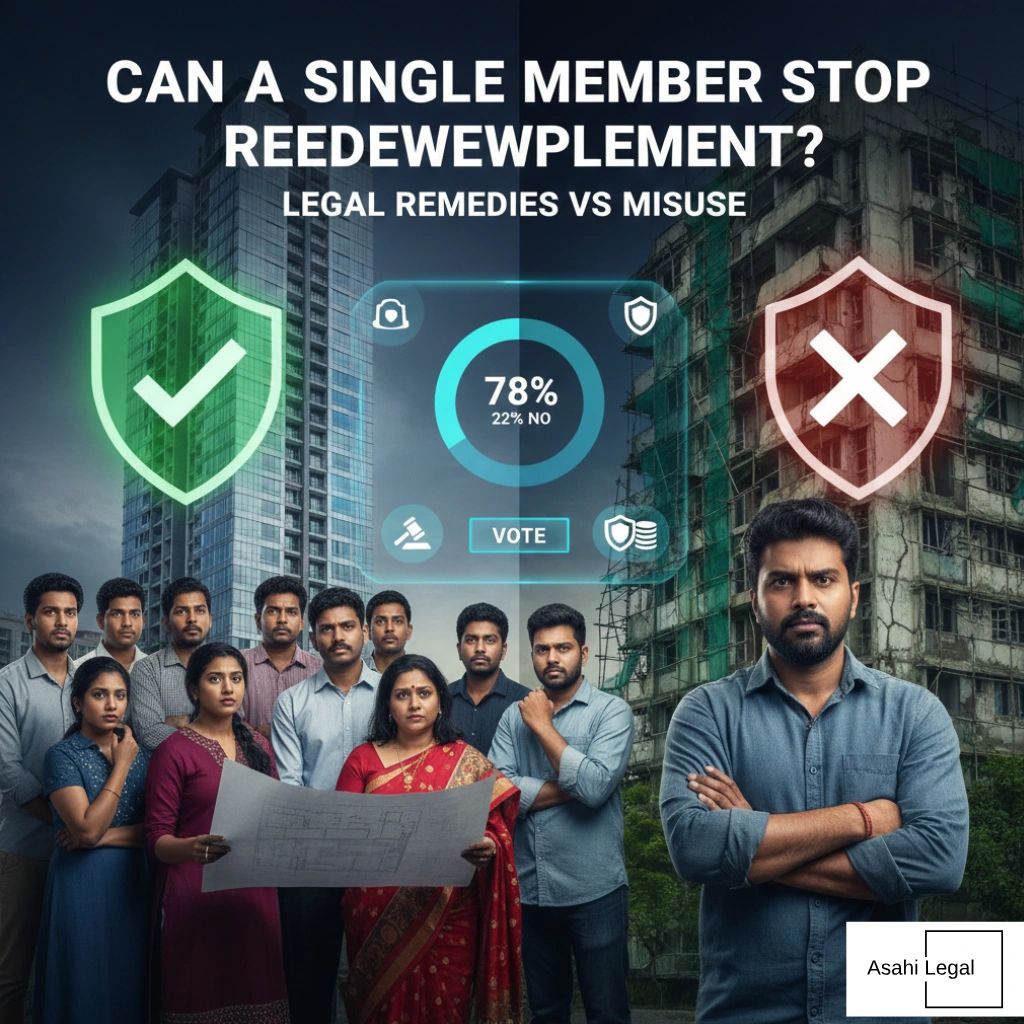
It’s a scenario played out in housing societies across India: 95% of members are ready to move into a modern building, but one or two members refuse to sign. They stop paying dues, ignore notices, or file endless court cases. This raises a million-dollar question: Can a single member legally hold a whole society to ransom?
In the past, a few “holdout” members could stall projects for decades. However, the legal tide has turned. While Indian law is deeply protective of individual property rights, it is even more protective of collective wisdom and public safety.
At Asahi Legal LLP, we specialize in balancing these scales. Whether you are a lone dissenter with genuine concerns or a society facing intentional obstruction, here is the legal reality of “The Minority vs. The Majority.”
- The Legal Reality: “Majority Rules”
In states like Maharashtra, the Section 79A guidelines and various High Court rulings have made one thing clear: redevelopment is a democratic process.
The Simple Truth
Once a society obtains the required majority consent (now 51% in many cases, though formerly 70-75%), the decision becomes binding on all members. An individual member does not have a “veto power” to stop a project simply because they don’t like it.
Legal Significance
The Bombay High Court has repeatedly held that a member of a Cooperative Housing Society (CHS) is part of a collective. By joining the society, you agree to abide by the decisions of the General Body. Individual proprietary rights are subservient to the interests of the society as a whole.
The court often uses the principle of “Subsumed Identity,” meaning once you are a member of a society, your individual identity is merged into the society for the purpose of such collective decisions.
- When Can a Member Legally Object? (Genuine Remedies)
Dissent is not always “obstruction.” There are valid legal grounds where a single member can—and should—challenge a redevelopment project.
Valid Legal Remedies:
- Procedural Fraud: If the society bypassed Section 79A—for example, by not inviting tenders, failing to hold a proper Special General Body Meeting (SGM), or not video-recording the proceedings.
- Discrimination: If the developer is offering extra area or money to some members (like committee members) but not others, violating the principle of equality.
- Financial Risk: If the developer is blacklisted, insolvent, or has failed to provide a mandatory Bank Guarantee (usually 20% of the project cost).
- Title Defects: If the society doesn’t actually own the land and is trying to redevelop it illegally.
- When Obstruction Becomes “Misuse”
Courts are now cracking down on members who use the legal system to “blackmail” builders for more money or better flat locations.
Common Signs of Misuse:
- Filing a case years after the Development Agreement was signed and most neighbors have already moved out.
- Refusing to vacate even after receiving rent, shifting charges, and hardship compensation.
- Demanding “under-the-table” payments to sign the consent letter.
The Court’s Response
Today, if a member files a “frivolous” suit to stop redevelopment, the courts can:
-
Impose Heavy Fines: Recent judgments have seen dissenting members fined upwards of ₹5 Lakhs for wasting judicial time and causing project costs to escalate.
-
Appoint a Court Receiver: This is the most powerful tool. The court can appoint a representative to forcibly take possession of the dissenting member’s flat and hand it over to the builder to ensure the project continues.
-
Expulsion: Under Section 35 of the MCS Act, a society can even move to expel a member who acts persistently against the interests of the society.
-
Remedies for the Society: How to Handle a Holdout
If your society is stuck because of one or two members, the law provides a clear path forward. You don’t have to wait forever.
Step-by-Step Recovery:
- Step 1: Transparency. Ensure every notice, minute, and circular is sent via Registered Post AD. This proves the member was informed and had a chance to participate.
- Step 2: Section 91 Dispute. The society can file a dispute in the Cooperative Court to enforce the resolution passed by the General Body.
- Step 3: Section 9 Arbitration Petition. If the development agreement has an arbitration clause, the developer/society can move the High Court for interim orders to secure possession of the dissenting member’s flat.
- Step 4: Specific Performance. Filing a suit to force the member to honor the collective contract signed by the society.
- The “Golden Mean”: How to Avoid Litigation
At Asahi Legal LLP, we always advise our clients that the best litigation is the one that never happens.
For Members:
If you have a grievance, voice it early. Get your objections recorded in the Minutes of the Meeting. If the society is acting unfairly, file a complaint with the Registrar of Societies immediately—don’t wait until the building is being demolished.
For Committees:
Be obsessively transparent. Record your SGMs on video. Provide every document—from the Feasibility Report to the Draft Development Agreement—to every member. When members feel “seen” and “heard,” they are less likely to run to court.
Conclusion: Collective Progress Wins
The legal landscape in India has evolved to ensure that one person cannot stop 100 people from living in a safe, modern building. While every member has the right to fairness, they do not have the right to obstruction without cause.
Are you a society dealing with a “holdout” member? Or a member who feels their rights are being trampled by a developer?
How Asahi Legal LLP Can Help:
- Interim Possession Orders: We help societies obtain court orders to move projects forward when a few members refuse to vacate.
- Section 79A Compliance Audits: We ensure your process is “bulletproof” so no one can challenge it on technicalities.
- Mediation & Resolution: We act as neutral legal advisors to resolve internal society conflicts before they reach the courtroom.
- Defense for Dissenters: If you are being genuinely defrauded, we provide the legal shield you need to protect your home.
Don’t let a single dispute derail your society’s future.
Contact Asahi Legal LLP today for a strategy session on handling redevelopment dissent.
Legal Disclaimer
Note: This post is for informational purposes only and does not constitute legal advice. Laws regarding redevelopment vary by state and are subject to frequent judicial updates. Please consult a qualified legal professional at Asahi Legal LLP for advice specific to your case.
This article is for general information only and is not legal advice or an invitation to engage the firm. Laws and judgments change; please obtain specific legal advice before acting.