
Introduction: The Hidden Price of “Winning”
In the modern Indian legal landscape, the definition of a “win” has fundamentally changed. For a business, a housing society, or an individual, obtaining a favorable judgment after a decade-long battle is often a pyrrhic victory. By the time the final decree is signed, the inflation-adjusted value of the recovery has diminished, business opportunities have been lost, and legal fees have likely ballooned beyond the original claim.
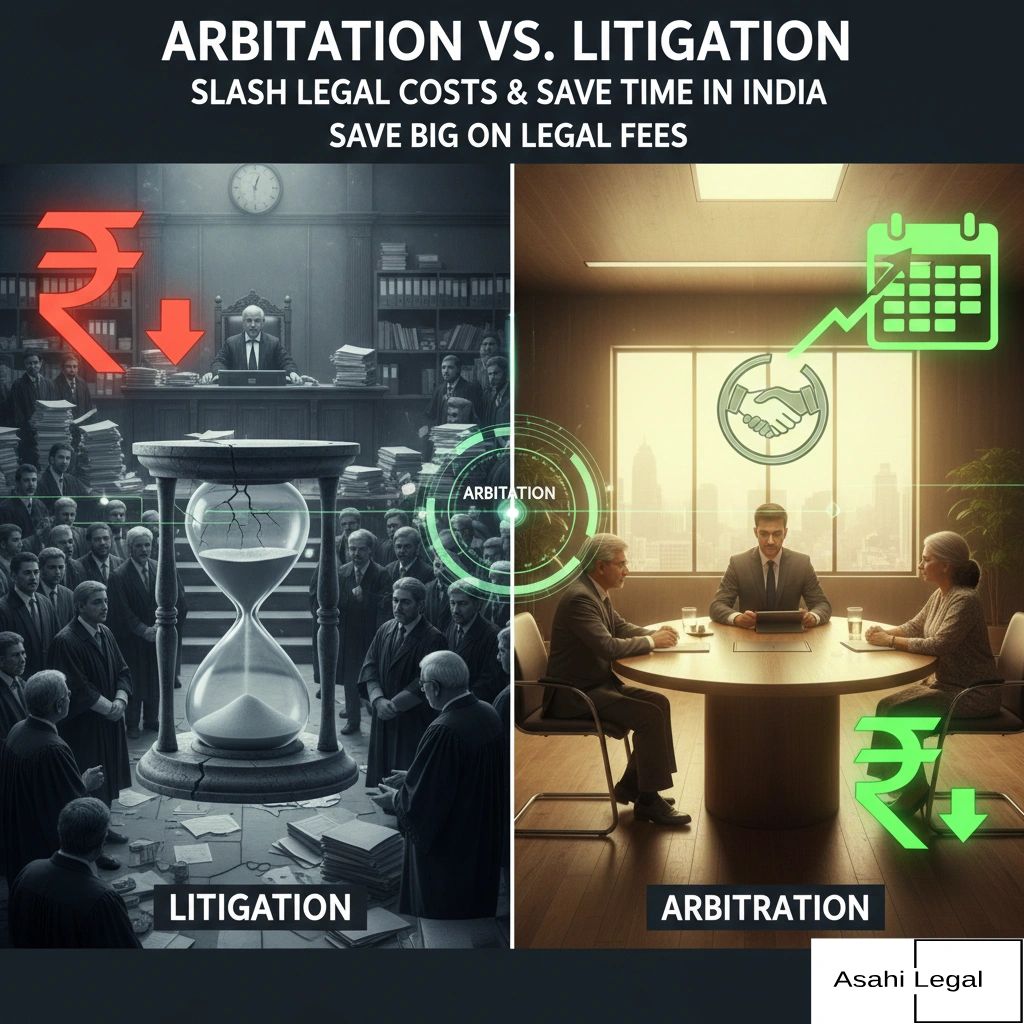
The question facing every litigant in 2026 is no longer just “Is my case strong?” but “Which forum offers the highest Return on Investment (ROI) for my legal spend?” This 2,000-word deep dive explores the financial architecture of dispute resolution, comparing the traditional courtroom to the modern arbitral tribunal, and providing a blueprint for slashing legal costs without compromising on results.
- The Financial Anatomy of Traditional Litigation
Litigation in India is governed by the Code of Civil Procedure (CPC). While it provides a robust framework for justice, it is inherently designed for “thoroughness” and “due process” rather than “speed” and “cost-efficiency.”
The “Adjournment Tax”
In a typical civil suit, every hearing date incurs a “cost of appearance.” Even if the judge is on leave, the courtroom is overcrowded, or the opposing counsel seeks a “date” (adjournment), your legal team has spent hours in preparation and travel.
- The Cumulative Bleed: If a senior counsel charges ₹2 Lakhs per appearance and a complex property case undergoes 40 hearings over five years, you have spent ₹80 Lakhs just for the “privilege” of waiting. In litigation, you are billed for process, not necessarily progress.
The Opportunity Cost of Stalled Assets
For real estate developers or housing societies, litigation often comes with an Interim Injunction. This freeze on the property is the most expensive part of the case.
- The Macro View: If a ₹500 Crore redevelopment project is stalled for 3 years due to a court case, the interest cost on the capital (at 10%) is ₹150 Crore. This “Hidden Cost” is often 100 times larger than the actual legal fees paid to the law firm.
The Appellate Ladder
A decree from a City Civil Court is rarely the end. The losing party almost always exercises their right to:
-
First Appeal: To the High Court (re-examining facts and law).
-
Second Appeal: On substantial questions of law.
-
Special Leave Petition (SLP): To the Supreme Court. In litigation, the “Cost of Finality” is unpredictable. You may “win” three times and still find yourself paying for a fourth round of litigation five years later.
-
Arbitration: The “Precision Tool” for Dispute Management
Arbitration is a private, contract-based dispute resolution mechanism. While it requires an upfront investment, it is designed to be a “closed-loop” system where the spending is finite.
Front-Loading the Cost
In arbitration, you pay for the Arbitrator’s time. In India, these fees are often guided by the Fourth Schedule of the Arbitration and Conciliation Act, which provides a structured slab based on the “Amount in Dispute.”
- Predictability: Unlike court, where you cannot predict how many hearings it will take to reach a judgment, an Arbitrator is focused solely on your case. While the initial fee feels “expensive,” it eliminates the “per-appearance” bleed that characterizes the court system.
The 12-Month Statutory “Clock”
Under Section 29A of the Act, an Arbitral Tribunal must pass an award within 12 months (extendable by 6 months with consent).
- The ROI: Resolving a dispute in 18 months instead of 8 years saves roughly 6.5 years of legal fees, administrative overhead, and mental stress.
Technical Expertise vs. Generalist Judges
In a complex construction or redevelopment dispute, a regular civil judge may struggle with technical engineering reports or architectural nuances.
- The Efficiency Gain: In arbitration, you can appoint an expert as your “judge.” If the Arbitrator already understands “FSI,” “TDR,” and “RERA compliance,” you save weeks of hearing time—and thousands in legal fees—that would otherwise be spent “educating” the court.
- The “Institutional” vs. “Ad-Hoc” Debate
Many litigants make the mistake of choosing “Ad-Hoc” arbitration (where parties pick a judge and meet at a hotel). This is often the most expensive way to resolve a dispute.
Why Institutional Arbitration (MCIA, IIAC) is Cheaper:
-
Fixed Fee Schedules: Institutions like the Mumbai Centre for International Arbitration (MCIA) have pre-set administrative fees. This prevents “fee creep” where arbitrators might otherwise charge for every minor application.
-
Logistical Savings: Courts are free but slow; hotels for ad-hoc meetings cost ₹20,000 to ₹50,000 per day. Institutions provide purpose-built rooms, stenography, and secretarial support as part of a fixed package.
-
Strict Supervision: Institutions monitor the progress of the case. If an arbitrator is dragging their feet, the institution can intervene. In ad-hoc arbitration, there is no “manager” to ensure the case stays on budget.
-
Tactical Asset Management: How to Slash Legal Fees by 40%
At Asahi Legal LLP, we advise our clients to treat their legal department like a “Lean Startup.” Here are the strategies we use to minimize legal spend:
I. The “Statement of Truth” Approach
In 2026, courts and tribunals are increasingly penalizing “frivolous” pleadings.
- Tactical Advice: Ensure your first draft is “Bulletproof.” Every time you have to “Amend” a pleading because of a forgotten fact, you pay for drafting, filing, and a hearing to allow that amendment. Precision in the first 30 days saves lakhs in the next 3 years.
II. The “Documentary Evidence” Audit
One of the biggest drivers of legal fees is “Review Time.” If you hand over a digital dump of 10,000 unorganized emails, your lawyers will charge you to read them all.
- Tactical Advice: Use an Internal Legal Auditor to filter relevant documents. If a lawyer spends 20 hours doing “Digital Garbage Collection,” you are paying senior-level rates for junior-level sorting.
III. Request “Documents-Only” Arbitration
Not every case needs a witness to take the stand. If the dispute is purely about interpreting a contract (e.g., “Was the notice period served correctly?”), oral cross-examination is often a waste of money.
- Tactical Advice: Agree to resolve the matter based on written submissions and documents alone. This can reduce the cost of an arbitration by 60% because you eliminate the most expensive part: the hearing days.
IV. Third-Party Funding (TPF)
TPF is an emerging trend in India where an outside investor pays for your legal fees in exchange for a percentage of the final recovery.
- Tactical Advice: For cash-strapped societies or companies with high-value claims, TPF turns a “Legal Liability” into a “No-Risk Asset.” If you lose, the funder loses their money. If you win, you share the proceeds.
- Mediation: The “Zero-Cost” Winner
The most affordable way to resolve a dispute is to never let it become a “legal” case. Under the Mediation Act, 2023, mediation has gained immense legal teeth.
- The Power of the Settlement: A “Mediated Settlement Agreement” is now as enforceable as a Court Decree.
- Cost Comparison: Mediation usually costs less than 5% of a full trial.
- The Emotional ROI: Mediation preserves relationships. In a housing society, where you have to live with your neighbors after the dispute, this is an invaluable (though non-monetary) saving.
- Case Study: The “Redevelopment Holdout” Math
The Scenario: A Housing Society with 100 members. 99 want to redevelop; 1 member refuses to vacate.
- Path A: Traditional Litigation
- The society files a suit for “Specific Performance.”
- The dissenter files an “Interim Application” to stop demolition.
- The case goes to the High Court on appeal.
- Time: 4 Years.
- Legal Fees: ₹25 Lakhs.
- Lost Rent/Hardship Allowance (for 99 families): ₹15 Crores.
- Total Loss: ₹15.25 Crores.
- Path B: Institutional Arbitration
- The Development Agreement has a mandatory arbitration clause.
- An Arbitrator is appointed within 30 days.
- A “Section 17” order is passed requiring the member to vacate.
- Award is passed in 12 months.
- Time: 14 Months.
- Legal & Arbitrator Fees: ₹35 Lakhs.
- Lost Rent (for 14 months): ₹4 Crores.
- Total Loss: ₹4.35 Lakhs.
The Result: Choosing Arbitration saved the society ₹10.9 Crores and nearly 3 years of life.
7.The Psychology of Litigation: Avoiding the “Sunk Cost Fallacy”
Many litigants continue to pour money into losing cases because they have already spent so much. This is the “Sunk Cost Fallacy.”
To save on legal fees, you must be willing to:
- Perform a “Mid-Trial” Audit: Every 6 months, ask your lawyer: “What is the probability of winning now, and what will it cost to get to the end?”
- Be the First to Offer Settlement: In the legal world, offering to settle isn’t a sign of weakness; it’s a sign of financial intelligence.
Conclusion: Justice as a Managed Service
At Asahi Legal LLP, our philosophy is that a lawyer’s primary job is to protect the client’s interests—and the client’s wallet is a major part of those interests. Whether you are a corporation managing a portfolio of contracts or a housing society committee member, the goal is the same: Finality at the lowest possible cost.
By prioritizing Arbitration over Litigation, utilizing Institutional frameworks, and being ruthlessly organized with your documentation, you can transform the legal process from a “cost center” into a “risk management” exercise. Justice should be accessible, but it shouldn’t be expensive.
Are you ready to audit your current legal disputes and find a more affordable path to resolution?
Contact Asahi Legal LLP today. Let us provide you with a “Legal Cost-Benefit Analysis” and help you move your disputes out of the backlog and into a resolution.
Legal Disclaimer
This guide is for informational purposes only and does not constitute legal advice. The costs and timelines mentioned are estimates based on 2026 market trends in India and are subject to change based on specific case complexities and jurisdictions. Always consult a qualified legal professional at Asahi Legal LLP for a customized strategy.
This article is for general information only and is not legal advice or an invitation to engage the firm. Laws and judgments change; please obtain specific legal advice before acting.