

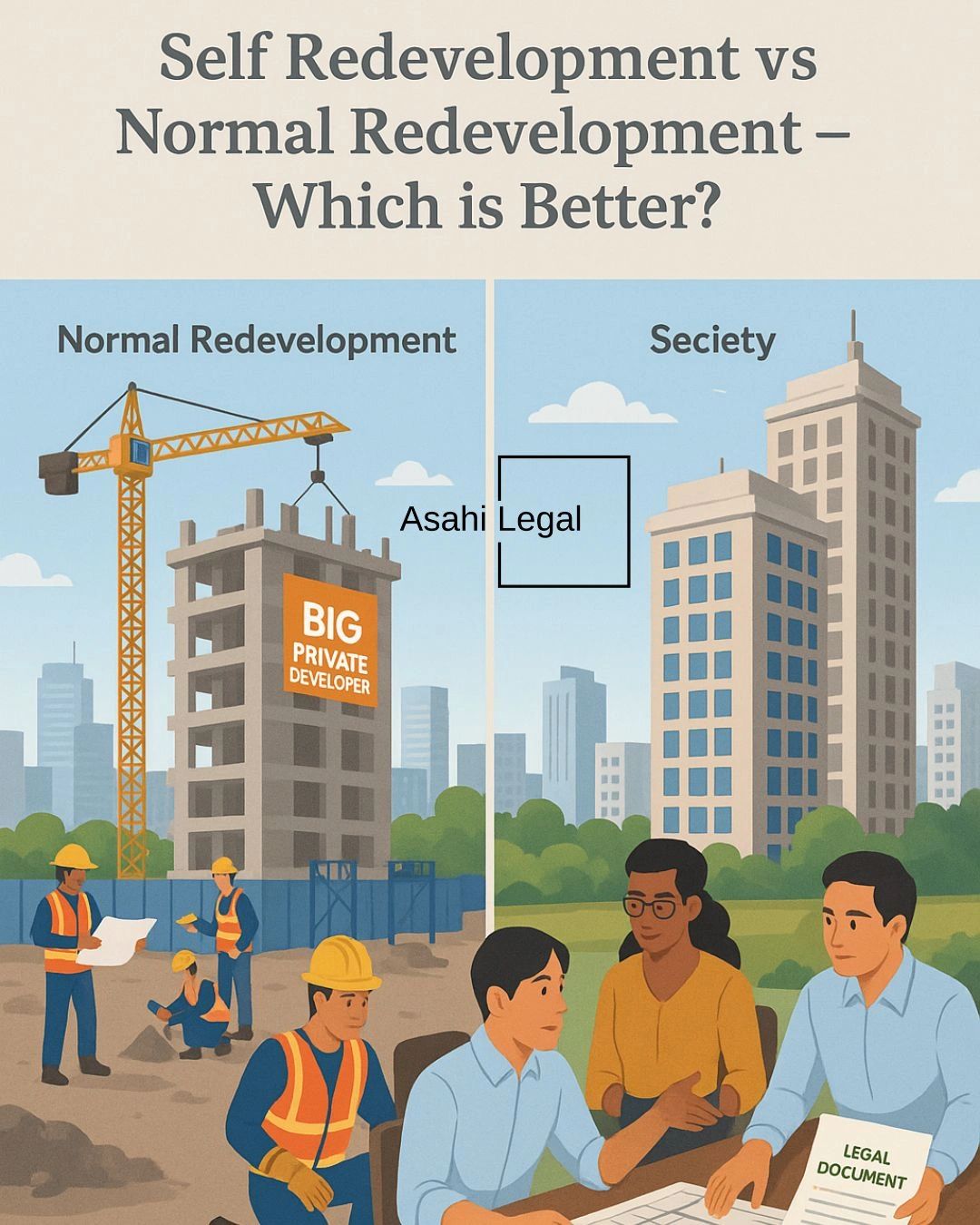
Self Redevelopment vs. Normal Redevelopment: Which is the Better Option for Housing Societies?
Introduction
Redevelopment of old and dilapidated buildings has become an unavoidable reality in cities like Mumbai, Thane, and Pune. With rising safety concerns, demand for modern amenities, and increasing land value, housing societies are often faced with the crucial question:
Should we opt for normal redevelopment through a developer, or should we take control and pursue self-redevelopment?
Both models have their own advantages and challenges. Understanding the difference between self-redevelopment and normal redevelopment is critical for societies before making a decision. At Asahi Legal, we regularly advise housing societies on redevelopment matters and help them make legally and financially sound choices.
What is Normal Redevelopment?
In normal redevelopment, a private developer or builder is appointed to carry out the project. The process typically involves:
-
Developer prepares plans and arranges finances.
-
Society members vacate flats and shift to transit housing or receive rent.
-
Developer demolishes and reconstructs the building.
-
Members get new flats (usually larger than the original) with modern amenities.
-
Developer sells additional flats in the open market to recover costs and earn profit.
This has been the most common redevelopment model in Maharashtra for decades.
What is Self Redevelopment?
In self-redevelopment, the society itself acts as the developer. Instead of handing over the project to a private builder, the society:
-
Applies for loans (often backed by government schemes like Mumbai District Central Co-operative Bank or nationalised banks).
-
Appoints architects, contractors, and project management consultants (PMC) independently.
-
Monitors construction through a redevelopment committee.
-
Retains full control over additional flats, corpus fund, and profits from saleable area.
Self-redevelopment has gained popularity after the Maharashtra government introduced policies supporting societies to undertake redevelopment without depending on private developers.
Key Differences Between Self Redevelopment and Normal Redevelopment
When a housing society decides on redevelopment, one of the most important choices is whether to go for normal redevelopment with a developer or opt for self redevelopment managed by the society. Below are the major differences explained in simple terms:
1. Control
In normal redevelopment, the developer controls planning, finances, and sale of flats. In self redevelopment, the society retains complete control over all project decisions, ensuring that members’ interests are prioritized.
2. Finance
Under normal redevelopment, the developer arranges all necessary funds. In self redevelopment, the society takes responsibility for financing, usually by obtaining loans from banks and financial institutions.
3. Profits from Saleable Area
In normal redevelopment, the profits from saleable flats are retained by the developer. By contrast, in self redevelopment, these profits remain with the society members, thereby increasing their financial benefit.
4. Risk
In normal redevelopment, the society depends on the credibility and financial stability of the developer. In self redevelopment, the risks are managed directly by the society, often with help from professional consultants and legal advisors.
5. Transparency
There are often complaints of lack of transparency in normal redevelopment, since the developer drives most decisions. Self redevelopment ensures greater transparency, as members themselves monitor and control the progress at every stage.
6. Timeframe
If a reputed developer is chosen, normal redevelopment is usually completed faster. However, self redevelopment may take longer because most societies lack prior experience in managing large-scale construction projects.
7. Corpus Fund and Rent
In normal redevelopment, the developer pays the corpus fund and compensates members with rent during the construction period. In self redevelopment, these payments must be managed by the society itself from the project finances.
Advantages of Normal Redevelopment
1. No Financial Burden on Society – The developer handles funding, rent, and construction costs.
2. Professional Expertise – Reputed developers have experience in handling permissions, contractors, and execution.
3. Speed – Projects can be completed faster if the developer is financially sound.
4. Convenience – Society members don’t have to get involved in day-to-day project execution.
Disadvantages of Normal Redevelopment
1. Loss of Profits – Developer retains saleable profits, leaving members with only flats and corpus.
2. Dependency on Developer – If the developer faces financial trouble, projects can get delayed or abandoned.
3. Transparency Issues – Many societies complain of hidden terms and lack of information sharing.
4. Quality Concerns – Some developers may compromise on quality to cut costs.
Advantages of Self Redevelopment
1. Retention of Profits – Society enjoys all profits from additional FSI/TDR and saleable flats.
2. Transparency and Control – Members make every decision collectively, ensuring accountability.
3. Better Amenities – Societies can plan larger flats, better parking, and improved common facilities without developer profit margins.
4. Government Support – Special schemes and loan facilities are available for societies opting for self-redevelopment.
5. No Dependency on Developers – Reduces risk of fraud, delays, or abandonment.
Disadvantages of Self Redevelopment
1. Financial Burden – Societies must take large loans and ensure repayment.
2. Lack of Expertise – Members may lack knowledge of construction, permissions, and project management.
-
Time-Consuming – Self-redevelopment projects often take longer due to delays in decision-making.
-
Internal Disputes – Differences among members regarding planning and profits can cause friction.
Which is Better: Self Redevelopment or Normal Redevelopment?
The choice depends on the priorities and capacity of the society:
Normal Redevelopment is better for societies that:
-
Want a hassle-free process.
-
Lack financial strength to take loans.
-
Prefer established developers handling execution.
Self Redevelopment is better for societies that:
-
Have strong internal unity and leadership.
-
Wish to maximize financial returns.
-
Are willing to take responsibility for project management.
At Asahi Legal, we often advise societies to carefully evaluate:
-
Financial feasibility (loan eligibility, repayment capacity).
-
Legal risks (agreements, permissions, member disputes).
-
Market potential (value of saleable flats).
Only after weighing these factors should a society finalize its choice.
Conclusion
Both self-redevelopment and normal redevelopment offer distinct advantages. While normal redevelopment provides convenience and less financial burden, self-redevelopment gives societies greater control and profit-sharing.
With government schemes, professional consultants, and strong legal guidance, self-redevelopment is becoming increasingly popular. However, it requires meticulous planning, legal compliance, and internal unity.
At Asahi Legal, we provide end-to-end legal support for both self-redevelopment and normal redevelopment projects. From drafting Development Agreements to assisting in loan documentation and dispute resolution, our team ensures that your society’s redevelopment journey is legally sound and financially beneficial.
If your housing society is considering redevelopment but unsure whether to choose self-redevelopment or normal redevelopment, expert legal advice can make all the difference.
📞Contact Asahi Legal today for a consultation. Our team will help you evaluate both options, safeguard your members’ rights, and ensure a smooth and transparent redevelopment journey.
This article is for general information only and is not legal advice or an invitation to engage the firm. Laws and judgments change; please obtain specific legal advice before acting.