
𝐔𝐍𝐀𝐔𝐓𝐇𝐎𝐑𝐈𝐙𝐄𝐃 𝐂𝐎𝐍𝐒𝐓𝐑𝐔𝐂𝐓𝐈𝐎𝐍𝐒 𝐁𝐘 𝐁𝐔𝐈𝐋𝐃𝐄𝐑𝐒 𝐀𝐍𝐃 𝐃𝐄𝐕𝐄𝐋𝐎𝐏𝐄𝐑𝐒 𝐈𝐍 𝐈𝐍𝐃𝐈𝐀 — 𝐀 𝐂𝐎𝐌𝐏𝐑𝐄𝐇𝐄𝐍𝐒𝐈𝐕𝐄 𝐋𝐄𝐆𝐀𝐋 𝐆𝐔𝐈𝐃𝐄 𝐁𝐘 𝐀𝐒𝐀𝐇𝐈 𝐋𝐄𝐆𝐀𝐋
𝐈𝐍𝐓𝐑𝐎𝐃𝐔𝐂𝐓𝐈𝐎𝐍
Unauthorized construction has become one of the most pressing urban challenges across India, particularly in states like Maharashtra where rapid development intersects with strict regulatory frameworks. Cities such as Mumbai, Thane, Navi Mumbai, Pune, and Nagpur have repeatedly witnessed instances where builders erect structures without sanctioned plans, exceed permissible Floor Space Index (FSI), add illegal floors, convert common areas, or alter approved layouts without consent from flat purchasers or authorities. These unauthorized constructions not only violate the law but create significant risks for purchasers, housing societies, lenders, and the city’s infrastructure.
Despite several judicial pronouncements and municipal regulations, unauthorized construction continues to plague the real estate sector. Homebuyers are often the ultimate victims, discovering only later that the building they occupy has illegal extensions, additional floors, unapproved wings, or deviations from the sanctioned plans. In certain cases, redevelopment projects are also affected when developers indulge in unauthorized work to generate additional revenue at the expense of structural safety and legal compliance.
At Asahi Legal, we regularly represent homebuyers, housing societies, and flat purchasers in disputes involving unauthorized constructions. This includes litigation before the Municipal Corporation, the Co-operative Court, RERA, and the Bombay High Court. This comprehensive guide aims to simplify complex legal concepts, helping both laypersons and law students understand the legal consequences, remedies, and preventive steps connected with unauthorized construction by builders and developers in India.
This article explains the legal meaning of unauthorized construction, the regulatory framework governing it, the liabilities of builders, the rights of flat purchasers and societies, and how courts approach demolition or regularization. It also discusses how Asahi Legal can assist in protecting the rights of purchasers and societies affected by such illegal development.
𝐖𝐇𝐀𝐓 𝐂𝐎𝐍𝐒𝐓𝐈𝐓𝐔𝐓𝐄𝐒 𝐔𝐍𝐀𝐔𝐓𝐇𝐎𝐑𝐈𝐙𝐄𝐃 𝐂𝐎𝐍𝐒𝐓𝐑𝐔𝐂𝐓𝐈𝐎𝐍?
Unauthorized construction refers to any construction carried out in violation of:
- sanctioned building plans
- Development Control Regulations (such as DCPR 2034 in Mumbai)
- Maharashtra Regional and Town Planning (MRTP) Act, 1966
- FSI or TDR norms
- environmental and fire-safety approvals
- consent of flat purchasers under the Maharashtra Ownership Flats Act (MOFA)
Typical examples include:
- adding extra floors not approved in the sanctioned plan
- constructing beyond the permissible FSI limit
- converting stilt parking or common areas into shops or lofts
- changing the building layout without the required consent of purchasers
- constructing additional wings, terraces, or rooms illegally
- encroaching upon open spaces, setbacks, or recreational grounds
- making vertical or horizontal extensions post-OC (Occupancy Certificate)
- unauthorized shops, mezzanine constructions, godowns, or sheds
Unauthorized construction is not merely a technical violation—it fundamentally affects safety standards, fire compliance, structural stability, and the rights of existing purchasers.
𝐋𝐄𝐆𝐀𝐋 𝐅𝐑𝐀𝐌𝐄𝐖𝐎𝐑𝐊 𝐆𝐎𝐕𝐄𝐑𝐍𝐈𝐍𝐆 𝐔𝐍𝐀𝐔𝐓𝐇𝐎𝐑𝐈𝐙𝐄𝐃 𝐂𝐎𝐍𝐒𝐓𝐑𝐔𝐂𝐓𝐈𝐎𝐍
Unauthorized construction is primarily regulated under:
- The Maharashtra Regional and Town Planning Act, 1966 (MRTP Act)
- Development Control and Promotion Regulations (DCPR)
- Maharashtra Ownership Flats Act (MOFA), 1963
- Real Estate (Regulation and Development) Act (RERA), 2016
- Municipal Corporation Acts (MMC Act/PMC Act/NMMC Act)
- Environment Protection Act (EPA)
- Fire safety rules and National Building Code
Under the MRTP Act, the Municipal Corporation has the authority to issue a stop-work notice, conduct inspections, initiate demolition, and prosecute the builder criminally. Under MOFA, the builder is prohibited from constructing additional structures without the written consent of flat purchasers. RERA further makes unauthorized construction a punishable offence and empowers homebuyers to seek compensation.
Unauthorized construction is treated as a serious violation, and municipal bodies are not permitted to regularize structures that are fundamentally contrary to planning norms.
𝐖𝐇𝐘 𝐁𝐔𝐈𝐋𝐃𝐄𝐑𝐒 𝐄𝐍𝐆𝐀𝐆𝐄 𝐈𝐍 𝐔𝐍𝐀𝐔𝐓𝐇𝐎𝐑𝐈𝐙𝐄𝐃 𝐂𝐎𝐍𝐒𝐓𝐑𝐔𝐂𝐓𝐈𝐎𝐍
Despite legal restrictions, builders sometimes undertake unauthorized construction due to:
- desire to maximize profit
- delay in obtaining approvals
- attempts to add extra units for sale
- lack of enforcement in certain areas
- buyer unawareness
- manipulation of layouts during construction
- opportunistic extensions in redevelopment projects
While the motivation may be monetary, the consequences fall disproportionately on purchasers and society members who are forced to fight prolonged legal battles to protect their homes.
𝐈𝐌𝐏𝐀𝐂𝐓 𝐎𝐅 𝐔𝐍𝐀𝐔𝐓𝐇𝐎𝐑𝐈𝐙𝐄𝐃 𝐂𝐎𝐍𝐒𝐓𝐑𝐔𝐂𝐓𝐈𝐎𝐍 𝐎𝐍 𝐇𝐎𝐌𝐄𝐁𝐔𝐘𝐄𝐑𝐒 𝐀𝐍𝐃 𝐇𝐎𝐔𝐒𝐈𝐍𝐆 𝐒𝐎𝐂𝐈𝐄𝐓𝐈𝐄𝐒
1. Risk of Demolition
The most direct impact is demolition. Courts have consistently held that unauthorized floors or structures must be removed, regardless of how many buyers occupy them.
2. Denial of Occupancy Certificate
Buildings with unauthorized extensions often never receive a valid OC, which affects:
- bank loans
- resale value
- electricity/water connection approvals
- property tax assessments
- insurance claims
3. Safety Concerns
Illegal construction compromises:
- fire exits
- structural strength
- ventilation
- drainage integration
4. Legal Liability
Societies that inherit unauthorized work post-redevelopment may face legal notices from municipal authorities.
5. Financial Loss
Homebuyers may lose lakhs during demolition proceedings or litigation.
Builders often abandon such projects, leaving societies to fight the legal consequences.
𝐒𝐓𝐎𝐏-𝐖𝐎𝐑𝐊 𝐍𝐎𝐓𝐈𝐂𝐄𝐒, 𝐃𝐄𝐌𝐎𝐋𝐈𝐓𝐈𝐎𝐍 𝐎𝐑𝐃𝐄𝐑𝐒, 𝐀𝐍𝐃 𝐌𝐔𝐍𝐈𝐂𝐈𝐏𝐀𝐋 𝐀𝐂𝐓𝐈𝐎𝐍
Under the MRTP Act, development without permission or contrary to sanction triggers the following steps:
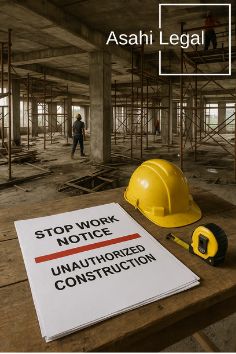
1. Stop-Work Notice under Section 52
This is the first warning directing the builder to cease construction immediately.
2. Inspection and Panchanama
Corporation officials document the illegal work.
3. Demolition Notice under Section 53
The builder is given a chance to remove the illegal structure voluntarily.
4. Sealing or Partial Demolition
Authorities may conduct demolition, sealing of floors, or removal of specific portions.
5. Criminal Proceedings
The builder faces criminal prosecution for unauthorized development.
6. Recovery of Demolition Costs
The cost of demolition is recovered from the builder.
Homebuyers may join proceedings to either challenge or support official action.
𝐂𝐀𝐍 𝐔𝐍𝐀𝐔𝐓𝐇𝐎𝐑𝐈𝐙𝐄𝐃 𝐂𝐎𝐍𝐒𝐓𝐑𝐔𝐂𝐓𝐈𝐎𝐍 𝐁𝐄 𝐑𝐄𝐆𝐔𝐋𝐀𝐑𝐈𝐙𝐄𝐃?
Regularization is allowed only if:
- The construction fits within planning norms
- additional FSI/TDR can legally cover the excess
- the construction does not violate safety or environmental rules
- penalties are paid
However, courts have consistently held that illegal construction cannot be legitimized merely because people occupy it. Public interest overrides private hardship.
Unauthorized structures on:
- RG areas
- No-Development Zones (NDZ)
- Coastal Regulation Zones (CRZ)
- public roads
- refuge areas
- fire evacuation spaces
can never be regularized.
𝐔𝐍𝐀𝐔𝐓𝐇𝐎𝐑𝐈𝐙𝐄𝐃 𝐂𝐎𝐍𝐒𝐓𝐑𝐔𝐂𝐓𝐈𝐎𝐍 𝐈𝐍 𝐑𝐄𝐃𝐄𝐕𝐄𝐋𝐎𝐏𝐌𝐄𝐍𝐓 𝐏𝐑𝐎𝐉𝐄𝐂𝐓𝐒
Redevelopment is particularly susceptible to unauthorized additions. Developers may try to:
- increase density without approval
- construct extra floors using “future FSI” not yet sanctioned
- alter layout plans without society consent
- change rehabilitation eligibility norms
- create additional sale components beyond permissible limits
Under DCPR 2034 and redevelopment guidelines:
- all plans must be transparently approved
- societies must receive copies of IOD, CC, sanctioned plans
- any alteration requires prior consent of society members
If a developer violates these rules, the society can:
- terminate the redevelopment agreement
- lodge complaints with MHADA/SRA/Corporation
- file RERA complaints
- file police complaints for cheating or fraud
- approach the High Court for urgent relief
At Asahi Legal, we frequently represent societies in redevelopment disputes, including unauthorized construction issues that arise after commencement of work.
𝐑𝐎𝐋𝐄 𝐎𝐅 𝐌𝐎𝐅𝐀 𝐀𝐍𝐃 𝐂𝐎𝐍𝐒𝐄𝐍𝐓 𝐎𝐅 𝐅𝐋𝐀𝐓 𝐏𝐔𝐑𝐂𝐇𝐀𝐒𝐄𝐑𝐒
Under Section 7 and Section 7A of MOFA, the developer cannot build any additional structure beyond what is shown in the original layout plan without obtaining written consent of flat purchasers.
Thus, unauthorized changes constitute a direct violation of MOFA, and affected buyers may:
- seek injunctions
- demand compensation
- file criminal complaints
- move RERA for refund or delay penalties
MOFA ensures buyer participation in the development process and is a powerful legal instrument when unauthorized work is detected.
𝐑𝐄𝐌𝐄𝐃𝐈𝐄𝐒 𝐀𝐕𝐀𝐈𝐋𝐀𝐁𝐋𝐄 𝐓𝐎 𝐇𝐎𝐌𝐄𝐁𝐔𝐘𝐄𝐑𝐒 𝐀𝐍𝐃 𝐒𝐎𝐂𝐈𝐄𝐓𝐈𝐄𝐒
When a developer carries out unauthorized construction, aggrieved parties may approach:
1. Municipal Corporation
To lodge an official complaint seeking inspection, stop-work orders, and demolition.
2. RERA
Homebuyers can file complaints seeking:
- refund
- compensation
- removal of illegal work
- compliance with sanctioned plans
3. Civil Court
To seek injunctions against unauthorized construction.
4. Co-operative Court
For society-related grievances, especially in redevelopment.
5. High Court (Writ Petition)
For urgent relief, especially where demolition has been ordered.
6. Police (Criminal Complaint)
Against the builder for cheating, misrepresentation, or fraud.
At Asahi Legal, we analyze the technical, municipal, and contractual documents to determine the most effective legal strategy.
𝐇𝐎𝐖 𝐓𝐎 𝐈𝐃𝐄𝐍𝐓𝐈𝐅𝐘 𝐈𝐅 𝐀 𝐁𝐔𝐈𝐋𝐃𝐈𝐍𝐆 𝐇𝐀𝐒 𝐔𝐍𝐀𝐔𝐓𝐇𝐎𝐑𝐈𝐙𝐄𝐃 𝐂𝐎𝐍𝐒𝐓𝐑𝐔𝐂𝐓𝐈𝐎𝐍
Homebuyers should verify:
- sanctioned plans from the Municipal Corporation
- IOD and CC conditions
- OC status
- approved layout plan
- fire approval plans
- RERA registration and plans
- deviations during on-site inspection
Societies should obtain the Final Sanctioned Plan and Completion Certificate before issuing NOCs for resale.
𝐂𝐎𝐔𝐑𝐓𝐒’ 𝐀𝐏𝐏𝐑𝐎𝐀𝐂𝐇 𝐓𝐎𝐖𝐀𝐑𝐃 𝐔𝐍𝐀𝐔𝐓𝐇𝐎𝐑𝐈𝐙𝐄𝐃 𝐂𝐎𝐍𝐒𝐓𝐑𝐔𝐂𝐓𝐈𝐎𝐍𝐒
Indian courts follow a strict “zero tolerance” approach. Key principles include:
- Illegal construction cannot be protected on grounds of sympathy
- Municipal corporations cannot be forced to regularize
- Buyer hardship does not justify retaining illegal floors
- Public safety and planning norms prevail
Demolition orders, though harsh, are often upheld to maintain rule of law.
𝐇𝐎𝐖 𝐀𝐒𝐀𝐇𝐈 𝐋𝐄𝐆𝐀𝐋 𝐇𝐄𝐋𝐏𝐒 𝐂𝐋𝐈𝐄𝐍𝐓𝐒 𝐈𝐍 𝐔𝐍𝐀𝐔𝐓𝐇𝐎𝐑𝐈𝐙𝐄𝐃 𝐂𝐎𝐍𝐒𝐓𝐑𝐔𝐂𝐓𝐈𝐎𝐍 𝐌𝐀𝐓𝐓𝐄𝐑𝐒
Asahi Legal provides end-to-end legal support for:
- homebuyers misled about sanctioned plans
- societies discovering unauthorized additions during redevelopment
- individuals facing municipal demolition action
- societies seeking to take action against errant developers
- purchasers needing clarity on compliance documents
- RERA disputes related to illegal construction
- High Court litigation challenging or defending demolition
Our team works with architects, structural engineers, and municipal consultants to build strong legal cases supported by technical evidence.
𝐂𝐎𝐍𝐂𝐋𝐔𝐒𝐈𝐎𝐍
Unauthorized construction by builders and developers is not a mere procedural lapse—it is a serious legal violation with long-term consequences for buyers, societies, and the city’s infrastructure. Awareness, due diligence, and timely legal action are essential to protect rights.
At Asahi Legal, we remain committed to assisting buyers and societies in identifying, challenging, and resolving disputes related to unauthorized construction. Whether through municipal proceedings, RERA, civil litigation, or redevelopment advisory, our firm offers comprehensive guidance tailored to each case.
📢 CALL TO ACTION
If you suspect unauthorized construction in your building or redevelopment project, or if you have received a notice from the municipal corporation, contact Asahi Legal today. Our team will guide you with precise legal strategy and complete documentation support.
📩 Reach out for a confidential consultation.
This article is for general information only and is not legal advice or an invitation to engage the firm. Laws and judgments change; please obtain specific legal advice before acting.