
For millions of residents living in aging cooperative housing societies across India’s Tier-1 cities, “Redevelopment” is the most significant financial and emotional event of a lifetime. It is the transition from a decaying, leak-prone structure to a modern, high-rise lifestyle. However, as the real estate market matures in 2026, the traditional “builder-led” model is no longer the only game in town.
Today, societies are at a crossroads. Should they trust a developer, take the reins themselves, or merge with their neighbors to transform an entire neighborhood? This 2,000-word deep dive provides a legal and strategic autopsy of the three primary models: Developer-Led, Self-Redevelopment, and Cluster Redevelopment.
1. Developer-Led Redevelopment: The Traditional “Hands-Off” Model
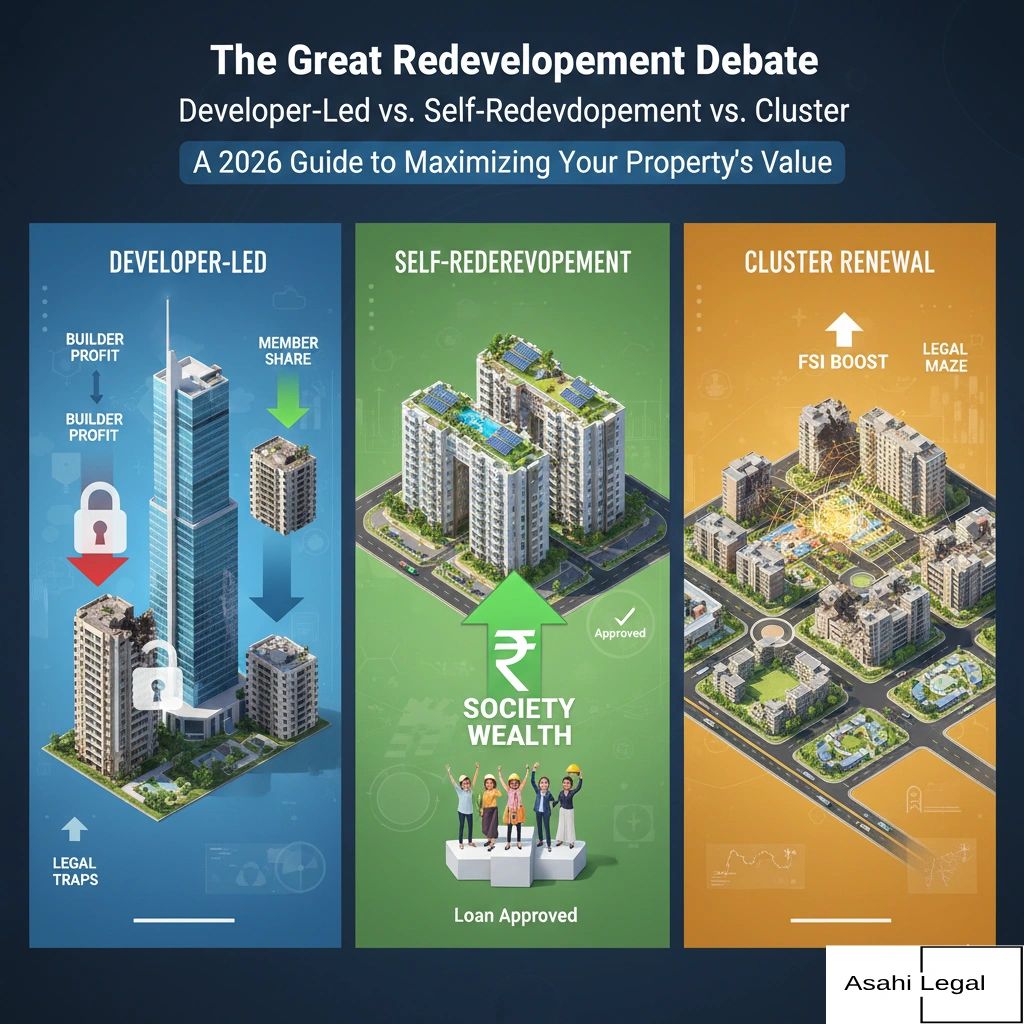
For decades, this has been the standard. In this model, the Society enters into a Development Agreement (DA) with a private builder. The builder demolished the existing structure, constructs a new one, and provides the existing members with new flats, a corpus fund, and rent for temporary accommodation.
The Financial Architecture
The developer funds the entire project. In exchange, they utilize the “Free Sale” component—the extra floor space granted by the government—to build additional apartments and sell them at market rates. The developer’s profit lies in the margin between the cost of construction/premiums and the final sales price.
Critical Legal Risks
- The Power of Attorney (PoA) Trap: Societies often grant an “Irrevocable PoA” to the builder. If the builder runs into financial trouble or redirects funds to other projects, the society is left stranded. The land is essentially “locked” under the builder’s rights.
- Delayed Possession: This is the #1 grievance in Indian real estate. While RERA (Real Estate Regulatory Authority) has brought discipline, many developer-led projects still face “timeline creep” due to liquidity crunches.
- Quality Compromise: Since the developer’s goal is to maximize profit, there is an inherent incentive to cut costs on the “rehab” wing while spending more on the “sale” wing.
When to Choose This:
This model is best for societies that have no appetite for financial risk, lack a cohesive or business-minded managing committee, and prefer a professional entity to handle the “liasing” with municipal authorities.
- Self-Redevelopment: The Rise of the “Society-as-Developer”
In the last five years, Self-Redevelopment has evolved from a niche experiment to a government-backed movement. Here, the Society replaces the builder. They hire their own architects, Project Management Consultants (PMCs), and contractors.
The Financial Revolution
Instead of giving away the “Free Sale” profit to a builder, the Society retains it.
- Example: If a builder offers 25% extra carpet area, a Self-Redevelopment model can often yield 40-50% extra area or a significantly larger corpus fund, because the “Developer’s Profit” (usually 20-30% of project value) is redistributed among the members.
The Legal Framework
The Society remains the absolute owner of the land and the structure throughout the process. They take a project loan from specialized banks (like State Cooperative Banks).
- The PMC’s Role: Since the committee members aren’t real estate experts, the Project Management Consultant is the legal and technical backbone. The contract with the PMC is the most important document in this model.
Key Challenges
- Financial Liability: The loan is in the Society’s name. If the extra flats don’t sell as expected, the members are responsible for the debt.
- Decision Fatigue: Every minor choice—from the brand of elevators to the color of the lobby—requires committee or General Body approval, which can lead to internal friction.
When to Choose This:
Self-Redevelopment is ideal for societies with high trust levels among members, a strong, transparent managing committee, and a plot located in a high-demand area where selling the “extra” flats is guaranteed.
3. Cluster Redevelopment: The “Township” Vision
Cluster Redevelopment (or Urban Renewal Schemes) is designed for congested areas with small, narrow plots that are individually unviable for modern construction. Under regulations like 33(9) in Mumbai, the government incentivizes multiple societies to merge their plots into one large “Cluster” (usually 4,000 sq. meters or more).
The Incentive Structure
The government provides a massive boost in Floor Space Index (FSI) to encourage cluster projects. By merging four or five small buildings, you can create a gated community with wide roads, massive gardens, and multi-level parking—things impossible on a single 500-sq. meter plot.
Legal Complexity: The “Multi-Society” Maze
Cluster projects are legally the most difficult to execute.
- Title Verification: You aren’t just checking one society’s papers; you are checking five. If even one building has a title defect or an unresolved mortgage, the entire cluster stalls.
- Consent Management: While the law may require 51% or 66% consent, getting five different General Bodies to agree on one developer or one plan is a Herculean task.
- The Urban Renewal Trust: Often, these projects require a separate legal entity to manage the interests of all participating buildings.
The “Master Developer” Model
Most clusters are developer-led because the sheer scale of construction (often ₹500 Cr+) is beyond the capacity of a cooperative society. However, the Society’s leverage is much higher here because of the sheer volume of FSI involved.
When to Choose This:
This is the only viable option for old “Cess” buildings, pagadi system properties, or very small plots that cannot afford to leave the mandatory “open spaces” required by modern building codes unless they merge with neighbors.
- Legal “Sanity Checks” for All Models
Regardless of which path your society takes, these legal pillars are non-negotiable:
I. The “Deemed Conveyance”
You cannot redevelop what you do not legally own. Many old societies are still in the name of the original landowner or the defunct builder. Obtaining a Deemed Conveyance is the mandatory “Step Zero.” Without it, no bank will fund you, and no municipal body will give you a Commencement Certificate (CC).
II. The Feasibility Study (The “Truth” Report)
Before talking to a builder or a bank, hire an independent consultant for a Feasibility Report.
- The Math: Total Plot Area + Permissible FSI + TDR (Transfer of Development Rights) + Fungible Compensatory Area = Total Construction Potential. If a developer promises more than this math allows, they are lying. If they promise less, they are pocketing your wealth.
III. GST and Taxation Implications
- In Developer-Led: The transfer of development rights is a taxable event under GST.
- In Self-Redevelopment: Taxation is handled differently since there is no “transfer” of rights to a third party. Incorrect tax planning can eat up 10-18% of your project budget.
IV. The RERA Shield
In 2026, every redevelopment project—regardless of the model—must be registered with RERA. This ensures that:
- 70% of the sale proceeds are kept in an escrow account.
- The developer (or the Society) cannot change the plans without 2/3rd consent of the buyers/members.
- There is a legal mechanism for compensation in case of delays.
- The “Dissenting Member” Problem
Every society has that one member who refuses to sign. Legally, the tide has turned against “unreasonable dissent.”
- The 51% Rule: Most states have lowered the consent requirement for redevelopment to 51%.
- Section 164 & 91 of the Co-operative Societies Act: Courts have repeatedly held that once a General Body passes a resolution for redevelopment, individual members cannot block it unless there is evidence of fraud or gross illegality. The “greater good” of the society outweighs the individual’s “veto.”
- Conclusion: Which Model Wins?
There is no “one-size-fits-all” answer.
- Developer-Led is a marriage of convenience. It’s for those who want a new home with minimal personal involvement.
- Self-Redevelopment is an entrepreneurial venture. It’s for societies that want to capture the “wealth” of their land rather than giving it away.
- Cluster Redevelopment is an urban transformation. It’s for those who realize that their neighborhood’s value is greater than their building’s value.
Redevelopment is a marathon, not a sprint. The “winner” is the society that spends the most time on due diligence and legal structuring before the first brick is laid.
Is your society ready for the next chapter?
Contact Asahi Legal LLP. We don’t just provide legal opinions; we provide strategic roadmaps. From vetting DAs and drafting PMCs to resolving dissenting member disputes and securing Deemed Conveyance, we ensure your redevelopment journey is legally sound and financially rewarding.
Legal Disclaimer
Note: This post is for informational purposes only. Please consult a qualified legal professional at Asahi Legal LLP for advice specific to your case.
This article is for general information only and is not legal advice or an invitation to engage the firm. Laws and judgments change; please obtain specific legal advice before acting.