

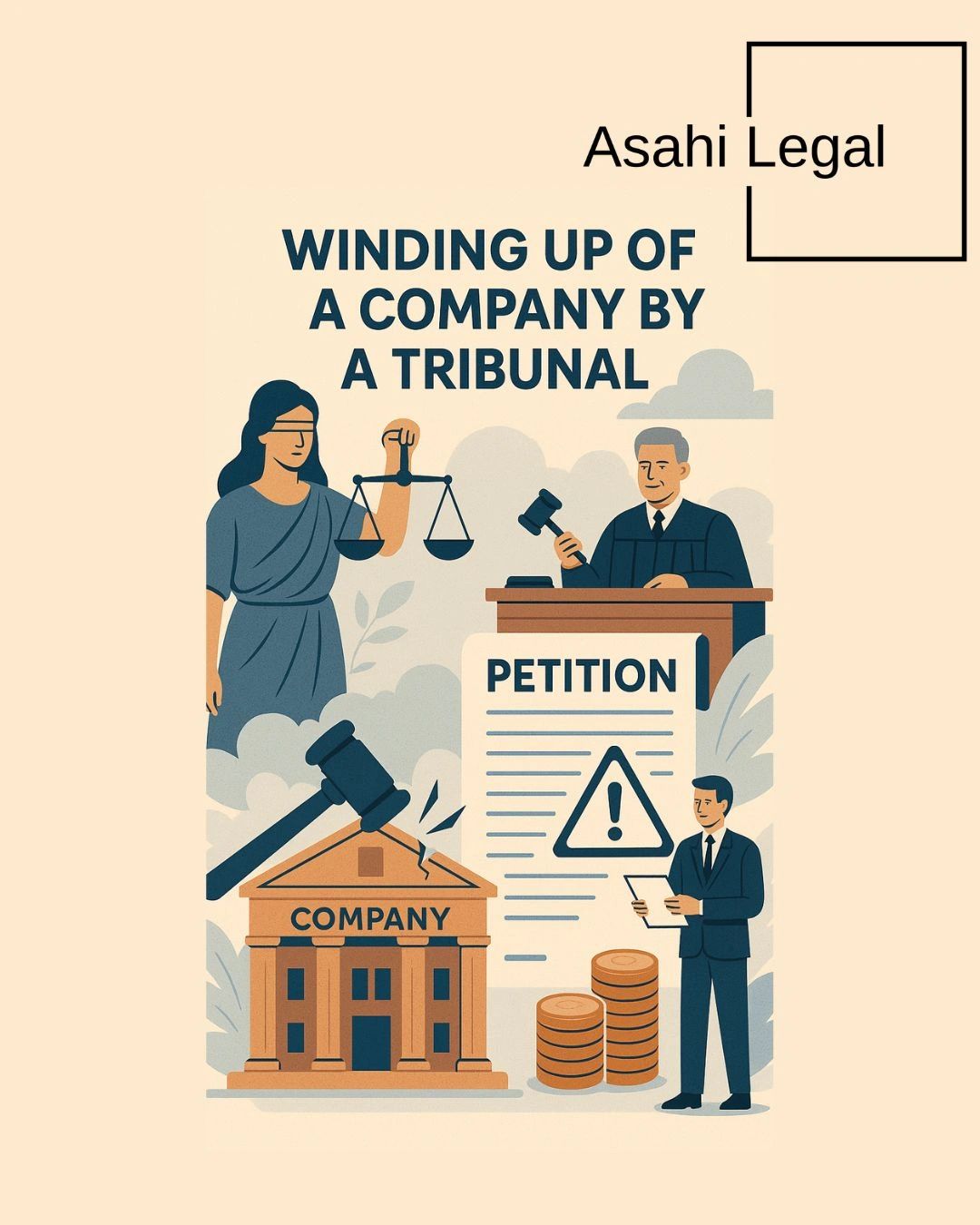
Winding Up of a Company by a Tribunal under the Companies Act, 2013
In the Indian corporate legal landscape, winding up marks the formal process through which a company ceases to operate and its legal existence is brought to an end. This structured dissolution ensures that the company’s assets are dealt with in an orderly manner, liabilities are paid off, and any surplus is returned to its stakeholders. The Companies Act, 2013—under Chapter XX—lays out comprehensive provisions for both voluntary winding up and winding up by the Tribunal. In particular, Sections 271 and 272 govern scenarios where judicial intervention becomes essential.
When a company is no longer financially viable, is misused for fraudulent purposes, or acts in a manner prejudicial to public interest, the law enables certain stakeholders to seek relief through the National Company Law Tribunal (NCLT). This ensures that companies that cannot or should not continue to exist are wound up under judicial oversight, in accordance with principles of fairness, legality, and economic efficiency.
Statutory Framework for Winding Up by Tribunal
Section 271 of the Companies Act, 2013 identifies specific grounds on which a company may be wound up by the Tribunal. A key trigger for such proceedings is the company’s inability to pay its debts. If a creditor has served a formal demand and the company fails to pay a debt of over ₹1 lakh within 21 days, it is presumed to be insolvent, allowing for a winding-up petition to be filed.
Another ground arises when the company itself passes a special resolution to be wound up. While this reflects shareholder intent, the Tribunal retains discretionary powers and will assess whether winding up serves the interests of justice and public good.
Additionally, a company can be ordered to be wound up if it has acted against the sovereignty and integrity of India, public order, morality, or relations with foreign states. These provisions are designed to safeguard national interest and ensure that companies operate within constitutional bounds.
Fraudulent conduct is yet another serious ground. If the company has been conducting its affairs in a deceitful manner or was formed with a fraudulent intent, the Tribunal may order winding up based on petitions filed by the Registrar of Companies or authorised government bodies.
Failure to comply with statutory obligations, such as the continuous non-filing of annual returns or financial statements for five consecutive years, is also a legitimate basis for winding up.
Lastly, if the Tribunal determines that it is just and equitable to wind up the company—such as in cases of management deadlock, total breakdown of trust between stakeholders, or loss of business purpose—it may pass a winding-up order to prevent further harm to stakeholders.
Who Can File for Winding Up and the Procedure Under Section 272
Section 272 enumerates the parties who are entitled to initiate winding-up proceedings. These include the company itself, its creditors, contributories (including fully paid-up shareholders), the Registrar of Companies, and persons authorised by the Central or State Government. Even prospective or contingent creditors may file a petition with prior permission from the Tribunal, provided they present a prima facie case and offer reasonable security for costs.
A company petitioning for its own winding up must submit a statement of affairs along with the petition. If the Registrar files the petition, it can only do so on certain specified grounds, thereby restricting abuse of the process.
Upon receiving a petition, the Tribunal may admit it and fix a date for hearing. If the petitioner is not the company, the company must be served notice and be given an opportunity to respond. The procedural rules ensure that all parties receive fair notice and are given a chance to present their case.
Compliance with the Companies (Winding Up) Rules, 2020
The procedural details of winding-up petitions are laid down in the Companies (Winding Up) Rules, 2020, which ensure that petitions are filed and adjudicated in a streamlined and transparent manner.
Petitions must be filed in Form WIN 1 or WIN 2, verified by an affidavit in Form WIN 3. Where required, a statement of affairs must be submitted in Form WIN 4, supported by an affidavit in Form WIN 5. These documents must reflect accurate information as of a date not earlier than 30 days before the petition’s filing.
Once admitted, the Tribunal directs the petition to be advertised in a widely circulated newspaper using Form WIN 6, at least 14 days before the hearing. This allows creditors, contributories, and other stakeholders to become aware of the proceedings and, if necessary, raise objections.
Affidavits-in-objection must be filed within 30 days of the Tribunal’s admission order. The petitioner then has seven days prior to the hearing to file and serve a reply. These strict timelines prevent unnecessary delay and promote procedural discipline.
The rules also provide for withdrawal of the petition (only with the Tribunal’s leave), substitution of petitioners when the original petitioner defaults or withdraws, and allow contributories to request copies of the petition upon payment of a nominal fee.
Real-Life Scenarios Leading to Winding Up
A number of factual circumstances can give rise to winding-up petitions. Insolvency is the most common—when a company cannot meet its financial obligations and fails to discharge admitted debts, creditors often initiate the winding-up process to recover dues.
Fraud and misconduct by promoters, such as siphoning of funds, accounting irregularities, or illegal diversion of resources, may also prompt shareholders, creditors, or regulatory authorities to seek judicial dissolution.
Persistent non-compliance with statutory filing requirements triggers action by the Registrar of Companies, especially when a company is suspected of being a dormant or shell entity.
In other cases, the company may have lost its “substratum”—its core business purpose. If the venture has failed commercially or the promoters are no longer interested in continuing operations, the Tribunal may find that there is no reason to keep the company alive.
Where disputes among directors or shareholders lead to a deadlock, and there is no prospect of revival or compromise, the Tribunal may invoke the “just and equitable” ground to bring an end to the company’s legal existence.
In rare but serious cases, such as where the company poses a threat to national security, public order, or decency, the government may initiate winding-up proceedings under the public interest clause.
Judicial Interpretation and Key Precedent
Indian courts have consistently upheld the principle that winding up is a measure of last resort. The Tribunal exercises significant discretion, balancing legal rights with equitable considerations.
In the notable case of Etisalat Mauritius Ltd. v. Etisalat DB Telecom (P) Ltd. (Company Petition No. 114 of 2012), the Tribunal faced a situation of irreconcilable deadlock between major stakeholders, which rendered the functioning of the company impossible. The Tribunal held that, given the absence of any workable revival plan or operational viability, the company ought to be wound up on “just and equitable” grounds.
This precedent underlines the judiciary’s role in protecting commercial certainty while ensuring justice in shareholder and creditor disputes.
Conclusion
The winding-up mechanism under the Companies Act, 2013, particularly Sections 271 and 272, along with the Companies (Winding Up) Rules, 2020, creates a robust legal and procedural framework for the dissolution of companies that have outlived their utility, acted illegally, or failed to operate in the interests of stakeholders. The Tribunal plays a pivotal role in safeguarding public interest, preventing abuse of corporate form, and ensuring orderly liquidation.
For stakeholders navigating this complex landscape—whether creditors seeking recovery, shareholders caught in management disputes, or companies themselves seeking closure—professional legal assistance is indispensable.
At Asahi Legal, we provide comprehensive support in initiating, defending, or advising on winding-up proceedings. Our experienced team ensures that each matter is addressed strategically, compliantly, and with a focus on client objectives.
#WindingUp #CompaniesAct #NCLT #CorporateDissolution #AsahiLegal #TribunalProceedings #Insolvency #CompanyLawIndia #BusinessClosure
This article is for general information only and is not legal advice or an invitation to engage the firm. Laws and judgments change; please obtain specific legal advice before acting.